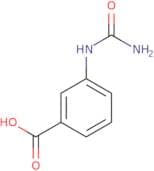
CAS 20632-43-3
:3-(carbamoylamino)benzoic acid
Description:
3-(Carbamoylamino)benzoic acid, also known as anthranilic acid, is an aromatic compound characterized by the presence of both an amino group and a carboxylic acid group attached to a benzene ring. This compound features a carbamoyl group (-C(=O)NH2) at the meta position relative to the carboxylic acid group. It is a white to off-white crystalline solid that is soluble in water and polar organic solvents. The presence of both functional groups allows it to participate in various chemical reactions, making it useful in organic synthesis and as a precursor for dyes, pharmaceuticals, and agrochemicals. Additionally, it exhibits biological activity, including potential roles in the synthesis of neurotransmitters and as a building block in the production of certain amino acids. Its CAS number, 20632-43-3, is a unique identifier that facilitates the identification and study of this compound in scientific literature and databases. Overall, 3-(carbamoylamino)benzoic acid is significant in both industrial applications and biological research.
Formula:C8H8N2O3
InChI:InChI=1/C8H8N2O3/c9-8(13)10-6-3-1-2-5(4-6)7(11)12/h1-4H,(H,11,12)(H3,9,10,13)
SMILES:c1cc(cc(c1)NC(=N)O)C(=O)O
Synonyms:- 3-[(Aminocarbonyl)Amino]Benzoic Acid
- Benzoic Acid, 3-[(Aminocarbonyl)Amino]-
- 3-(Carbamoylamino)Benzoate
Sort by
Purity (%)
0
100
|
0
|
50
|
90
|
95
|
100
Found 3 products.
3-[(Aminocarbonyl)amino]benzoic acid
CAS:Formula:C8H8N2O3Color and Shape:SolidMolecular weight:180.16073-Ureidobenzoic acid
CAS:3-Ureidobenzoic acid is an organic compound that can act as a reducer or bidentate ligand. The reductive properties of 3-ureidobenzoic acid are due to its ability to accept electrons from other molecules, which can be used to reduce metal ions. The ligand properties of 3-ureidobenzoic acid are due to the formation of a covalent bond with other molecules, often metal ions. 3-Ureidobenzoic acid is also known to be a synthetase, which catalyzes the formation of peptide bonds in proteins by joining amino acids together. This compound has been found in cytochrome P450 enzymes, where it is believed to play a role in electron transfer and activation reactions. It has also been shown to be involved in supramolecular hydrogen bonding, which stabilizes certain compounds and plays an important role in enzyme activity and intermolecular reactions.Formula:C8H8N2O3Purity:Min. 95%Molecular weight:180.16 g/mol
![3-[(Aminocarbonyl)amino]benzoic acid](/_next/image/?url=https%3A%2Fstatic.cymitquimica.com%2Fproducts%2FIN%2Fthumb%2FDA002IFA.jpg&w=3840&q=75)