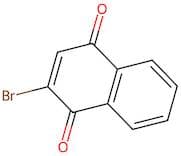
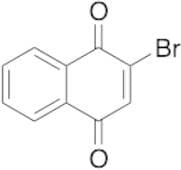
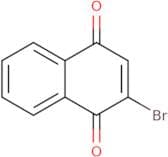
CAS 2065-37-4
:2-bromonaphthalene-1,4-dione
Description:
2-Bromonaphthalene-1,4-dione, with the CAS number 2065-37-4, is an organic compound characterized by its naphthalene backbone substituted with a bromine atom and two carbonyl groups at the 1 and 4 positions. This compound typically appears as a solid and is known for its yellow to orange color. It is a derivative of naphthalene, which contributes to its aromatic properties and stability. The presence of the bromine atom enhances its reactivity, making it useful in various chemical reactions, including electrophilic substitution and nucleophilic addition. The carbonyl groups impart significant polar character, influencing its solubility in organic solvents. 2-Bromonaphthalene-1,4-dione is often utilized in organic synthesis, particularly in the development of dyes, pharmaceuticals, and agrochemicals. Its reactivity and structural features make it a valuable intermediate in the synthesis of more complex organic molecules. Safety precautions should be observed when handling this compound, as it may pose health risks if inhaled or ingested.
Formula:C10H5BrO2
InChI:InChI=1/C10H5BrO2/c11-8-5-9(12)6-3-1-2-4-7(6)10(8)13/h1-5H
SMILES:c1ccc2c(c1)C(=O)C=C(C2=O)Br
Sort by
Purity (%)
0
100
|
0
|
50
|
90
|
95
|
100
Found 5 products.
2-BROMO-1 4-NAPHTHOQUINONE 98
CAS:Formula:C10H5BrO2Purity:95%Color and Shape:SolidMolecular weight:237.04952-Bromo-1,4-naphthoquinone
CAS:Controlled ProductApplications 2-Bromo-1,4-naphthoquinone is a structural analog of Vitamin K3 (V676130) and has been used in cancer research studies to increase H2O2 production in tumor cell lines.
References Graciani, F.S., et al.: Braz. J. Med. Biol. Res., 45, 701 (2012)Formula:C10H5BrO2Color and Shape:NeatMolecular weight:237.052-Bromo-1,4-naphthoquinone
CAS:2-Bromo-1,4-naphthoquinone is an organic compound with a hydroxyl group. In vitro studies have shown that it has minimal toxicity and redox potentials similar to those of water. 2-Bromo-1,4-naphthoquinone has been found to be reactive and nucleophilic in biological studies. It is also anticancer active when used in tissue culture and has been shown to inhibit the growth of cancer cells by interfering with cellular metabolism. The mechanism of action includes reactions with amines at the C2 position of the naphthoquinone ring, which leads to a release of bromine radicals that react with DNA and other cell components.Formula:C10H5BrO2Purity:Min. 95%Molecular weight:237.05 g/mol