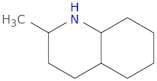
CAS 20717-43-5
:Quinoline, decahydro-2-methyl-
Description:
Decahydro-2-methylquinoline, with the CAS number 20717-43-5, is a bicyclic organic compound belonging to the quinoline family. It features a saturated ring structure, which distinguishes it from its unsaturated counterparts. This compound is characterized by its relatively low polarity and moderate solubility in organic solvents, making it useful in various chemical applications. Decahydro-2-methylquinoline typically exhibits a distinct odor and is colorless to pale yellow in appearance. Its molecular structure includes a nitrogen atom within the ring, contributing to its basicity and potential reactivity in chemical reactions. This compound is often studied for its applications in organic synthesis, as well as in the development of pharmaceuticals and agrochemicals. Additionally, it may serve as an intermediate in the synthesis of more complex molecules. Safety data indicates that, like many organic compounds, it should be handled with care, as it may pose health risks upon exposure.
Formula:C10H19N
Sort by
Purity (%)
0
100
|
0
|
50
|
90
|
95
|
100
Found 4 products.
2-Methyldecahydroquinoline
CAS:Formula:C10H19NPurity:98.0%Color and Shape:LiquidMolecular weight:153.26462-Methyldecahydroquinoline (mixture of isomers)
CAS:2-Methyldecahydroquinoline (mixture of isomers)Purity:>98.0%2-Methyldecahydroquinoline (mixture of isomers)
CAS:Formula:C10H19NPurity:>98.0%(T)Color and Shape:Colorless to Light yellow to Light orange clear liquidMolecular weight:153.272-Methyl-decahydroquinoline
CAS:2-Methyl-decahydroquinoline is a chemical compound of the quinoline group. It is a colorless solid that can be prepared by reacting carbon disulfide with chloroacetanilides in the presence of hydrochloric acid. The reaction mechanism of 2-methyl-decahydroquinoline is based on the substitution of chlorine by hydrogen, which produces an alkylthio group. This compound can be used to treat wastewater and has been found to have growth regulatory properties when used as an alkylsulfonyl fluoride reagent. It also has been shown to be a potential intermediate for the synthesis of thiocarbamates, oxime derivatives, and c1-c4 haloalkyls.
Formula:C10H19NPurity:Min. 95%Molecular weight:153.26 g/mol