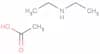
CAS 20726-63-0
:Diethylammonium acetate
Description:
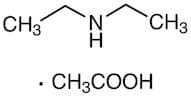
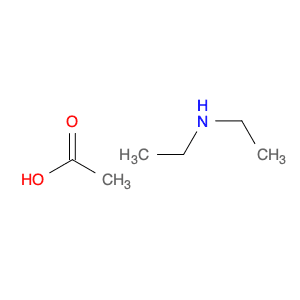
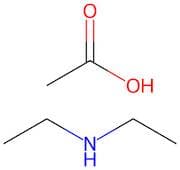
Diethylammonium acetate is an organic compound characterized by its structure, which consists of a diethylammonium cation and an acetate anion. It is typically a colorless to pale yellow liquid or solid, depending on its form and purity. This compound is soluble in water and polar organic solvents, making it useful in various applications, including as a reagent in organic synthesis and as a potential ionic liquid. Diethylammonium acetate exhibits properties typical of ammonium salts, such as being hygroscopic and having a relatively low melting point. Its molecular structure allows for hydrogen bonding, which contributes to its solubility and interaction with other substances. Additionally, it may exhibit basic properties due to the presence of the ammonium group, which can participate in acid-base reactions. Safety data should be consulted for handling and storage, as with any chemical substance, to ensure proper precautions are taken.
Formula:C4H11N·C2H4O2
InChI:InChI=1S/C4H11N.C2H4O2/c1-3-5-4-2;1-2(3)4/h5H,3-4H2,1-2H3;1H3,(H,3,4)
InChI key:InChIKey=UEHUZQKLOWYOMO-UHFFFAOYSA-N
SMILES:N(CC)CC.C(C)(O)=O
Synonyms:- Diethylamine, acetate
- Ethanamine, N-ethyl-, acetate
- Ethanamine, N-ethyl-, acetate (1:1)
- Diethylammonium acetate
Sort by
Purity (%)
0
100
|
0
|
50
|
90
|
95
|
100
Found 4 products.
Diethylamine Acetate
CAS:Formula:C4H11N·C2H4O2Purity:>97.0%(T)Color and Shape:White to Light yellow powder to crystalMolecular weight:133.19acetic acid; diethylamine
CAS:Formula:C6H15NO2Purity:97%Color and Shape:SolidMolecular weight:133.1888Diethylamine Acetate
CAS:Diethylamine acetate is a fatty acid that is used as a building block for the synthesis of polymers. It has been shown to be genotoxic in human liver cells and human serum, and it has been found to induce DNA damage in these cells. Diethylamine acetate is also used in the preparation of fatty acids for molecular biology studies. This compound reacts with hydrophilic interaction chromatography (HILIC) stationary phases by forming ionic interactions with the polar groups on the stationary phase. This reaction mechanism can be used to separate biologically active molecules from other compounds that are not as polar. Diethylamine acetate can also be used in liquid chromatography methods, immunochemical assays, and clinical studies.
Formula:C4H11N·C2H4O2Purity:Min. 95%Color and Shape:PowderMolecular weight:133.19 g/mol