CAS 20731-63-9
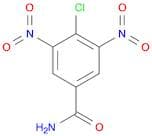
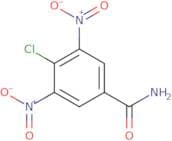
:4-Chloro-3,5-dinitrobenzamide
Description:
4-Chloro-3,5-dinitrobenzamide is an organic compound characterized by its aromatic structure, which includes a benzene ring substituted with a chlorine atom and two nitro groups at the 3 and 5 positions, along with an amide functional group. This compound typically appears as a yellow to orange solid and is known for its relatively low solubility in water, but it may dissolve in organic solvents. The presence of the nitro groups contributes to its potential as a nitrating agent and influences its reactivity, making it of interest in various chemical syntheses and applications. Additionally, the chlorine substituent can enhance the compound's electrophilic properties. 4-Chloro-3,5-dinitrobenzamide is often studied for its biological activity, including potential use in pharmaceuticals or as a pesticide, although safety and environmental considerations are paramount due to the toxicity associated with nitro compounds. Proper handling and disposal are essential due to its hazardous nature.
Formula:C7H4ClN3O5
InChI:InChI=1/C7H4ClN3O5/c8-6-4(10(13)14)1-3(7(9)12)2-5(6)11(15)16/h1-2H,(H2,9,12)
InChI key:InChIKey=XIYABENEBOSULF-UHFFFAOYSA-N
SMILES:N(=O)(=O)C1=C(Cl)C(N(=O)=O)=CC(C(N)=O)=C1
Synonyms:- NSC 76582
- Benzamide, 4-chloro-3,5-dinitro-
- 4-Chloro-3,5-dinitrobenzamide
- Einecs 243-998-5
- 3,5-DINITRO-4-CHLOROBENZAMIDE
Sort by
Purity (%)
0
100
|
0
|
50
|
90
|
95
|
100
Found 3 products.
4-Chloro-3,5-dinitrobenzamide
CAS:4-Chloro-3,5-dinitrobenzamide is a bifunctional molecule that contains a chlorine atom. It has been found to react with dipolar solutes as well as vicinal dioxan arylation. The nucleophilic amide group is also labile and can be hydrolyzed by strong acids or bases. The electron lone pair of the chlorine atom in 4-chloro-3,5-dinitrobenzamide can be used for electrophilic substitution reactions with aromatic rings or amines. This molecule has been found to undergo an arylation reaction with imidazole in the presence of dioxan solvent at room temperature.Formula:C7H4ClN3O5Purity:Min. 95%Molecular weight:245.58 g/mol