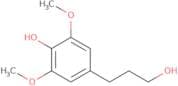
CAS 20736-25-8
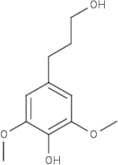
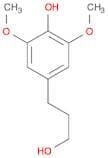
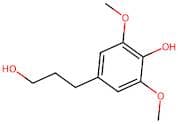
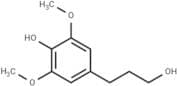
:4-(3-hydroxypropyl)-2,6-dimethoxyphenol
Description:
4-(3-Hydroxypropyl)-2,6-dimethoxyphenol, with the CAS number 20736-25-8, is an organic compound characterized by its phenolic structure, which includes two methoxy groups and a hydroxypropyl substituent. This compound typically exhibits properties associated with phenols, such as being a weak acid due to the presence of the hydroxyl group. The methoxy groups contribute to its hydrophobic character, while the hydroxypropyl group enhances its solubility in polar solvents. It may display antioxidant properties, making it of interest in various applications, including cosmetics and pharmaceuticals. The compound's molecular structure suggests potential for interactions with biological systems, possibly influencing its reactivity and stability. Additionally, its synthesis and handling require standard laboratory safety protocols due to the potential for reactivity typical of phenolic compounds. Overall, 4-(3-hydroxypropyl)-2,6-dimethoxyphenol is a versatile compound with unique characteristics that can be leveraged in multiple fields of research and industry.
Formula:C11H16O4
InChI:InChI=1/C11H16O4/c1-14-9-6-8(4-3-5-12)7-10(15-2)11(9)13/h6-7,12-13H,3-5H2,1-2H3
SMILES:COc1cc(CCCO)cc(c1O)OC
Synonyms:- Benzenepropanol, 4-Hydroxy-3,5-Dimethoxy-
Sort by
Purity (%)
0
100
|
0
|
50
|
90
|
95
|
100
Found 6 products.
Dihydrosinapyl alcohol
CAS:Dihydrosinapyl alcohol analytical standardFormula:C11H16O4Color and Shape:PowderMolecular weight:212.25Benzenepropanol, 4-hydroxy-3,5-dimethoxy-
CAS:Formula:C11H16O4Purity:95%Color and Shape:SolidMolecular weight:212.2423Dihydrosinapyl alcohol
CAS:Dihydrosinapyl alcohol (Dihydrosinapylalcohol) is a natural product from Clerodendranthus spicatus.Formula:C11H16O4Purity:98.92% - 99.26%Color and Shape:SolidMolecular weight:212.243,5-Dimethoxy-4-hydroxyhydrocinnamyl alcohol
CAS:3,5-Dimethoxy-4-hydroxyhydrocinnamyl alcohol is a phenolic compound, which is a derivative of cinnamyl alcohol and known for its antioxidant properties. It is typically isolated from plant sources, especially those with rich secondary metabolite profiles such as certain herbs and spices. The compound functions by donating hydrogen atoms to free radicals, thereby neutralizing them and preventing oxidative stress on cells.Formula:C11H16O4Purity:Min. 95%Color and Shape:White PowderMolecular weight:212.24 g/mol4-(3-Hydroxypropyl)-2,6-dimethoxyphenol
CAS:Formula:C11H16O4Purity:95%Color and Shape:SolidMolecular weight:212.245