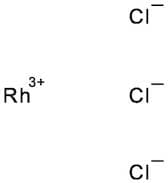
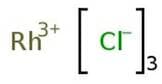
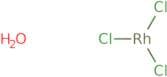
CAS 20765-98-4
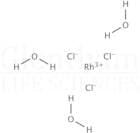
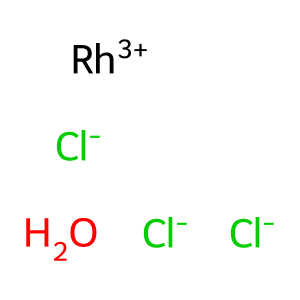
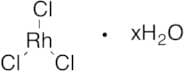
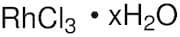
:Rhodium trichloride hydrate
- Rhodium (III) nitrate dihydrate
- Rhodium chloride (RhCl<sub>3</sub>), hydrate
- Rhodium chloride hydrate
- Rhodium trichloride hydrate
- Rhodium(+3) Cation Chloride Hydrate
- Rhodium(III) Chloride, hydrate
- RhodiumchloridehydrateRh
- Trichlororhodium Trihydrate
- Rhodium chloride (RhCl3), hydrate
Rhodium(III) chloride hydrate, Premion™, 99.99% (metals basis)
CAS:Rhodium(III) chloride hydrate is used as a catalyst for the conversion of methane to acetic acid, isomerization of alkenes, reduction of aromatic rings and hydration of acetylene. It is involved in the hydrosilylation of alfa,beta-unsaturated esters to form dimethylketene trimethylsilyl acetals. It
Formula:Cl3RhPurity:99.99%Molecular weight:209.26Rhodium(III) chloride hydrate, Rh 38.0-45.5%
CAS:Rhodium(III) chloride hydrate is used as a catalyst to prepare acetic acid. It is also used as a catalyst for reduction, oxidation of alkenes, hydration of acetylene and isomerization of alkenes. It is involved in the hydrosilylation of alfa,beta-unsaturated esters to form dimethylketene trimethylsiFormula:Cl3RhMolecular weight:209.26Rhodium(III) chloride hydrate (38-41% Rh)
CAS:Rhodium(III) chloride hydrate (38-41% Rh)
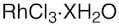
Formula:RhCl3·XH2OColor and Shape:dark red pwdr.Molecular weight:209.28Rhodium chloride (RhCl3), hydrate (9CI)
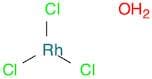
CAS:Formula:Cl3H2ORhPurity:98%Color and Shape:SolidMolecular weight:227.2798Ref: IN-DA002J6J
1g278.00€5gTo inquire10gTo inquire25gTo inquire50gTo inquire100gTo inquire100mg71.00€250mg110.00€Rhodium(III) chloride hydrate, 99.95% (metals basis)
CAS:Formula:RhCl3·xH2OPurity:≥ 99.95%Color and Shape:Brown to dark brown or dark red powder or crystalsMolecular weight:209.26Rhodium(III) chloride hydrate
CAS:Rhodium(III) chloride hydratePurity:≥95%Color and Shape:Brown CrystalsMolecular weight:227.28g/molRhodium(III) Chloride Hydrate
CAS:Controlled ProductApplications Rhodium(III) chloride is often used in synthetic chemistry as a hydrogenation catalyst. Rhodium(III) chloride is also used to make transition metal complexes, some of which are used as reagents in the decarbonylation dehydration reactions of fatty acids to alkenes.
References Foglia, T. & Barr, P.: J. Am. Oil Chem. Soc., 53, 737 (1976); Hillis, J. & DeArmond, M.: J. Lum., 4, 273 (1971); James, B. & Rempel, G.: Can. J. Chem., 44, 233 (1966)Formula:Cl3Rh·xH2OColor and Shape:Dark BrownMolecular weight:209.26Rhodium (III) Chloride Trihydrate pure, 98%
CAS:Formula:RhCl3·3H2OColor and Shape:Brown, Crystalline powderMolecular weight:263.31Rhodium(III) chloride hydrate
CAS:Formula:Cl3H2ORhPurity:95.0%Color and Shape:Solid, Dark red powderMolecular weight:227.27Rhodium(III) chloride hydrate
CAS:Rhodium(III) chloride hydrate is a catalyst that is used in the oxidation of aromatic hydrocarbons. It has been shown to have an acidic reaction with hydrochloric acid and is used in the oxidation of benzene, toluene, ethylbenzene, and xylene. Rhodium(III) chloride hydrate has also been shown to be a good catalyst for the production of polycyclic aromatic hydrocarbons from light emitting diodes. This product can be used as an oxidizing agent in organic synthesis reactions. The 6-Fluoro-3-indoxyl-beta-D-galactopyranoside is an antituberculosis drug that belongs to the class of rifamycins. It is the most active of the rifamycins for the treatment of tuberculosis. Rifapentine inhibits bacterial growth by binding to DNA-dependent RNA polymerase, thereby preventing transcription and replication. The high frequency of
Formula:RhCl3·xH2OPurity:Min. 95%Molecular weight:209.26 g/mol