CAS 20780-77-2
:6-Iodo-1H-Indole-2,3-dione
Description:
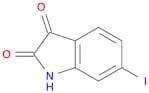
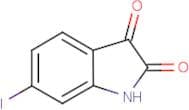
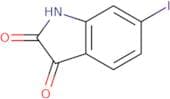
6-Iodo-1H-Indole-2,3-dione, with the CAS number 20780-77-2, is a chemical compound that belongs to the indole family, characterized by its fused bicyclic structure containing a nitrogen atom. This compound features an iodine atom at the 6-position and two carbonyl groups at the 2 and 3 positions of the indole ring, contributing to its reactivity and potential biological activity. It is typically a solid at room temperature and may exhibit a range of colors depending on its purity and form. The presence of the iodine substituent can influence its electronic properties, making it a candidate for various chemical reactions, including electrophilic substitutions. Additionally, compounds of this type may exhibit interesting pharmacological properties, making them of interest in medicinal chemistry. Its solubility can vary based on the solvent used, and it may participate in various chemical reactions, including oxidation and reduction processes. Safety data should be consulted for handling, as with all chemical substances, to ensure proper precautions are taken.
Sort by
Purity (%)
0
100
|
0
|
50
|
90
|
95
|
100
Found 4 products.
1H-Indole-2,3-dione, 6-iodo-
CAS:Formula:C8H4INO2Purity:95%Color and Shape:SolidMolecular weight:273.02736-Iodo-2,3-dihydro-1H-indole-2,3-dione
CAS:6-Iodo-2,3-dihydro-1H-indole-2,3-dionePurity:95%Color and Shape:SolidMolecular weight:273.03g/mol6-Iodoisatin
CAS:6-Iodoisatin is a potential anticancer agent that has been shown to inhibit the growth of murine melanoma cells in vitro. The mechanism of action is not yet fully understood, but it seems that 6-iodoisatin may inhibit the synthesis of melanin and its cross-coupling reaction. This compound also exhibits affinity for tumour cells and can be radiolabeled with a radionuclide such as iodine-131 (I) or iodine-123 (I). 6-Iodoisatin has been shown to have a high biodistribution profile in mice. It accumulates in melanoma tumours at an amount that is ten times higher than that observed in other tissues.
Formula:C8H4INO2Purity:Min. 95%Color and Shape:Orange PowderMolecular weight:273.03 g/mol