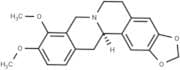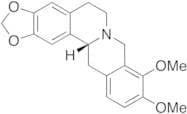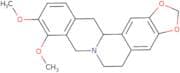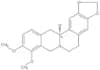
CAS 2086-96-6
:(+)-Tetrahydroberberine
Description:
(+)-Tetrahydroberberine is a naturally occurring alkaloid derived from the plant Berberis, known for its potential therapeutic properties. It is characterized by its molecular structure, which includes a tetrahydroisoquinoline framework, contributing to its biological activity. This compound is typically found in a crystalline form and exhibits a yellowish color. (+)-Tetrahydroberberine is recognized for its ability to interact with various biological targets, including its role in modulating metabolic pathways and its potential effects on glucose metabolism and lipid profiles. It has garnered interest in the field of pharmacology for its possible applications in treating conditions such as diabetes and metabolic syndrome. The compound is soluble in organic solvents but has limited solubility in water, which can affect its bioavailability. Additionally, its stereochemistry plays a crucial role in its pharmacological effects, with the (+) enantiomer often being the focus of research due to its enhanced activity compared to other forms. Overall, (+)-Tetrahydroberberine represents a significant area of study in natural product chemistry and medicinal applications.
Formula:C20H21NO4
InChI:InChI=1S/C20H21NO4/c1-22-17-4-3-12-7-16-14-9-19-18(24-11-25-19)8-13(14)5-6-21(16)10-15(12)20(17)23-2/h3-4,8-9,16H,5-7,10-11H2,1-2H3/t16-/m1/s1
InChI key:InChIKey=VZTUIEROBZXUFA-MRXNPFEDSA-N
SMILES:O(C)C1=C2CN3[C@@](C=4C(=CC5=C(C4)OCO5)CC3)(CC2=CC=C1OC)[H]
Synonyms:- d-Canadine
- (13aR)-5,8,13,13a-Tetrahydro-9,10-dimethoxy-6H-benzo[g]-1,3-benzodioxolo[5,6-a]quinolizine
- 6H-Benzo[g]-1,3-benzodioxolo[5,6-a]quinolizine, 5,8,13,13a-tetrahydro-9,10-dimethoxy-, (R)-
- Berbine, 9,10-dimethoxy-2,3-(methylenedioxy)-, (+)-
- 6H-Benzo[g]-1,3-benzodioxolo[5,6-a]quinolizine, 5,8,13,13a-tetrahydro-9,10-dimethoxy-, (13aR)-
Sort by
Purity (%)
0
100
|
0
|
50
|
90
|
95
|
100
Found 3 products.
(R)-(+)-Tetrahydroberberine
CAS:<p>(R)-(+)-Tetrahydroberberine, the inactive isomer of (S)-(-)-Tetrahydroberberine, serves as an experimental control. The latter, an alkaloid and intermediate in berberine biosynthesis, exhibits insecticidal activity [1].</p>Formula:C20H21NO4Color and Shape:SolidMolecular weight:339.39(R)-(+)-Canadine
CAS:Controlled Product<p>Applications (R)-(+)-Canadine is a protoberberine alkaloid with central depressant action and adenylate cyclase inhibitor activity.<br>References Sheppard, H. & Burghardt, C.: Biochem. Pharmacol., 27, 1113 (1978); Yamahara, J. et al.: Chem. Pharm. Bull., 24, 1909 (1976)<br></p>Formula:C20H21NO4Color and Shape:NeatMolecular weight:339.39(R)-(+)-Canadine
CAS:<p>(R)-(+)-Canadine is a naturally occurring alkaloid, which is an isoquinoline compound most commonly sourced from plants like Berberis and Corydalis species. It plays a crucial role in the plant's defense mechanisms, particularly due to its structural and functional properties. The mode of action of (R)-(+)-Canadine involves the inhibition of various enzymes, including those linked to microbial growth. This gives it significant antimicrobial properties, which have been studied for potential applications in combating bacterial infections. Additionally, (R)-(+)-Canadine exhibits interactions with cellular ion channels, contributing to its broader pharmacological effects.</p>Formula:C20H21NO4Purity:Min. 95%Molecular weight:339.4 g/mol