CAS 20862-11-7
:(±)-Desisopropylpropranolol
Description:
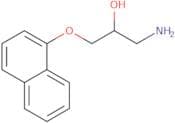
(±)-Desisopropylpropranolol, with the CAS number 20862-11-7, is a chemical compound that serves as a derivative of propranolol, a well-known non-selective beta-adrenergic antagonist. This substance is characterized by its chiral nature, existing as a racemic mixture of its enantiomers. It is primarily recognized for its potential pharmacological effects, which may include modulation of cardiovascular responses and influence on the central nervous system. The compound features a naphthalene ring structure, contributing to its lipophilicity, which allows for effective membrane permeability. Its solubility profile typically indicates moderate solubility in organic solvents, while being less soluble in water. As a research chemical, (±)-Desisopropylpropranolol is often studied for its interactions with beta-adrenergic receptors and its implications in various therapeutic contexts. Safety and handling precautions are essential due to its biological activity, and it is important to consider its potential effects in both clinical and experimental settings.
Formula:C13H15NO2
InChI:InChI=1S/C13H15NO2/c14-8-11(15)9-16-13-7-3-5-10-4-1-2-6-12(10)13/h1-7,11,15H,8-9,14H2
InChI key:InChIKey=ZFMCITCRZXLMDJ-UHFFFAOYSA-N
SMILES:O(CC(CN)O)C=1C2=C(C=CC1)C=CC=C2
Synonyms:- N-Desisopropylpropranolol
- 1-Amino-3-(1-naphthalenyloxy)-2-propanol
- Desisopropylpropranolol
- 2-Propanol, 1-amino-3-(1-naphthyloxy)-
- 2-Propanol, 1-amino-3-(1-naphthalenyloxy)-
Sort by
Purity (%)
0
100
|
0
|
50
|
90
|
95
|
100
Found 3 products.
1-Amino-3-(naphthalen-1-yloxy)propan-2-ol
CAS:1-Amino-3-(naphthalen-1-yloxy)propan-2-ol (NAP) is a metabolite of propranolol. It is an inhibitor of cytochrome P450, which prevents the metabolism of propranolol and other drugs. NAP inhibits the activity of human liver microsomes in vitro, but does not inhibit the activity of rat liver microsomes. This may be due to the matrix effect on enzymes. NAP has been shown to have an inhibitory effect on a number of enzymes, including rat liver microsomes, human liver microsomes, and model systems such as fluorescence detection. NAP also reacts with propranolol hydrochloride to form naphthalene derivatives that are detectable using a fluorescence detector. The chemical structures for NAP and propranolol hydrochloride can be found below:Formula:C13H15NO2Purity:Min. 95%Molecular weight:217.26 g/mol