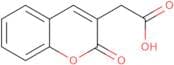
CAS 20862-58-2
:2H-1-Benzopyran-3-acetic acid, 2-oxo-
Description:
2H-1-Benzopyran-3-acetic acid, 2-oxo- (CAS 20862-58-2) is a chemical compound that belongs to the class of flavonoids, specifically a type of coumarin derivative. This compound features a benzopyran structure, which is characterized by a fused benzene and pyran ring, and contains an acetic acid functional group and a keto group at the 2-position. Its molecular structure contributes to its potential biological activities, including antioxidant and anti-inflammatory properties. The compound is typically a white to off-white solid and is soluble in organic solvents. It may exhibit various pharmacological effects, making it of interest in medicinal chemistry and natural product research. As with many organic compounds, its stability and reactivity can be influenced by environmental factors such as pH and temperature. Safety data should be consulted for handling and usage, as with any chemical substance.
Formula:C11H8O4
Synonyms:- 2-(2-oxochromen-3-yl)ethanoic acid
- (2-Oxo-2H-chromen-3-yl)acetic acid
- 2-(2-OXO-2H-CHROMEN-3-YL)ACETIC ACID
- 2H-1-Benzopyran-3-acetic acid, 2-oxo-
- 2-(2-oxochromen-3-yl)acetic acid
- 2-(2-oxo-3-chromenyl)acetic acid
- Acetic acid, 2-(coumarin-3-yl)-
- AKOS MSC-0227
- Coumarin-3-acetic acid
- 2-(2-ketochromen-3-yl)acetic acid
Sort by
Purity (%)
0
100
|
0
|
50
|
90
|
95
|
100
Found 1 products.
(2-Oxo-2H-chromen-3-yl)acetic acid
CAS:(2-Oxo-2H-chromen-3-yl)acetic acid is a molecule that has been shown to have antibacterial activity against Staphylococcus aureus and other bacteria. It is an amide that reacts with lysine residues in the bacterial cell wall, which leads to inhibition of growth. (2-Oxo-2H-chromen-3-yl)acetic acid also has conjugates with malic acid, which can be used as a fluorescent indicator for its presence in bacterial cells. This compound has been shown to be active against Gram-positive and Gram-negative bacteria, but not against Mycobacterium tuberculosis or Mycobacterium avium complex. The dilution method is used to determine the concentration of this compound in bacterial cells.
Formula:C11H8O4Purity:Min. 95%Color and Shape:PowderMolecular weight:204.18 g/mol