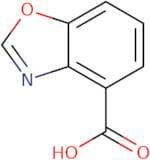
CAS 208772-23-0
:4-Benzoxazolecarboxylic acid
Description:
4-Benzoxazolecarboxylic acid is an organic compound characterized by its benzoxazole ring structure, which consists of a fused benzene and oxazole ring, along with a carboxylic acid functional group. This compound typically appears as a white to off-white solid and is known for its potential applications in pharmaceuticals and materials science due to its heterocyclic nature. The presence of the carboxylic acid group contributes to its acidity and reactivity, allowing it to participate in various chemical reactions, such as esterification and amidation. Additionally, 4-benzoxazolecarboxylic acid may exhibit biological activity, making it of interest in medicinal chemistry. Its solubility properties can vary depending on the solvent, and it may be soluble in polar organic solvents. The compound's molecular structure allows for potential interactions with biological targets, which can be explored in drug development. Overall, 4-benzoxazolecarboxylic acid is a versatile compound with significant relevance in both synthetic and applied chemistry.
Formula:C8H5NO3
Synonyms:- Benzo[D]Oxazole-4-Carboxylic Acid
Sort by
Purity (%)
0
100
|
0
|
50
|
90
|
95
|
100
Found 4 products.
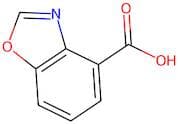
BENZO[D]OXAZOLE-4-CARBOXYLIC ACID
CAS:Formula:C8H5NO3Purity:97%Color and Shape:SolidMolecular weight:163.13021,3-Benzoxazole-4-carboxylic acid
CAS:1,3-Benzoxazole-4-carboxylic acidPurity:97%Color and Shape:Pale Yellow SolidMolecular weight:163.13g/molBenzo[d]oxazole-4-carboxylic acid
CAS:Formula:C8H5NO3Purity:95%Color and Shape:No data available.Molecular weight:163.1321,3-Benzoxazole-4-carboxylic acid
CAS:1,3-Benzoxazole-4-carboxylic acid is a metabolite of benzoxazinone and has been shown to have antibiotic properties. It was found to inhibit the growth of bacteria by binding to their ribosomes and inhibiting protein synthesis. This compound also inhibits acetylcholinesterase activity in tissues and skeletal muscle, which may be due to its ability to bind with phosphatidic acid and phospholipases. 1,3-Benzoxazole-4-carboxylic acid has been shown to accumulate in the esophagus in rats after oral administration. In one study, this compound was found to reduce the number of colonies grown on plates containing strains of E. coli and S. aureus.
Formula:C8H5NO3Purity:Min. 95%Molecular weight:163.13 g/mol
![BENZO[D]OXAZOLE-4-CARBOXYLIC ACID](/_next/image/?url=https%3A%2Fstatic.cymitquimica.com%2Fproducts%2FIN%2Fthumb%2FDA002JVW.jpg&w=3840&q=75)


![Benzo[d]oxazole-4-carboxylic acid](/_next/image/?url=https%3A%2Fstatic.cymitquimica.com%2Fproducts%2F10%2Fthumb%2FF220709.jpg&w=3840&q=75)