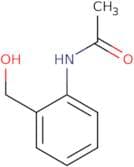
![N-[2-(hydroxymethyl)phenyl]acetamide](/_next/image/?url=https%3A%2Fstatic.cymitquimica.com%2Fcas-image%2Fthumb-webp%2F127952-n-2-hydroxymethyl-phenyl-acetamide.webp&w=3840&q=75)
CAS 20939-77-9
:N-[2-(hydroxymethyl)phenyl]acetamide
Description:
N-[2-(hydroxymethyl)phenyl]acetamide, with the CAS number 20939-77-9, is an organic compound characterized by its amide functional group. It features a phenyl ring substituted with a hydroxymethyl group at the ortho position relative to the acetamide moiety. This structure imparts both hydrophilic and lipophilic characteristics, making it potentially useful in various chemical applications. The presence of the hydroxymethyl group enhances its solubility in polar solvents, while the acetamide group contributes to its ability to participate in hydrogen bonding. This compound may exhibit biological activity, making it of interest in pharmaceutical research. Its melting point, solubility, and reactivity can vary based on environmental conditions and the presence of other substances. As with many organic compounds, safety precautions should be observed when handling N-[2-(hydroxymethyl)phenyl]acetamide, as it may pose health risks if ingested or inhaled. Overall, its unique structural features suggest potential utility in medicinal chemistry and related fields.
Formula:C9H11NO2
InChI:InChI=1/C9H11NO2/c1-7(12)10-9-5-3-2-4-8(9)6-11/h2-5,11H,6H2,1H3,(H,10,12)
SMILES:CC(=Nc1ccccc1CO)O
Sort by
Purity (%)
0
100
|
0
|
50
|
90
|
95
|
100
Found 4 products.
Acetamide, N-[2-(hydroxymethyl)phenyl]-
CAS:Formula:C9H11NO2Purity:95%Color and Shape:SolidMolecular weight:165.1891N-[2-(Hydroxymethyl)phenyl]acetamide
CAS:N-[2-(Hydroxymethyl)phenyl]acetamidePurity:95%Molecular weight:165.19g/mol2-Acetamidobenzyl alcohol
CAS:2-Acetamidobenzyl alcohol is a hapten that binds to the antibody. This chemical has been shown to have a tetrahedral, cyclic, and magnetic structure. The kinetic of this substance was studied using magnetic resonance studies, which showed that it reacts with pyridoxal and then becomes an acetamide derivative. It also has a carbonyl group and can be observed by using magnetic resonance studies. 2-Acetamidobenzyl alcohol is absorbed by macromolecules such as proteins and amino acids in the body and can be seen in absorbed resonance studies.Formula:C9H11NO2Purity:Min. 95%Molecular weight:165.19 g/mol
![Acetamide, N-[2-(hydroxymethyl)phenyl]-](/_next/image/?url=https%3A%2Fstatic.cymitquimica.com%2Fproducts%2FIN%2Fthumb%2FDA002K7E.jpg&w=3840&q=75)

![N-[2-(Hydroxymethyl)phenyl]acetamide](/_next/image/?url=https%3A%2Fstatic.cymitquimica.com%2Fproducts%2F54%2Fthumb%2FOR950936.jpg&w=3840&q=75)