CAS 20968-04-1
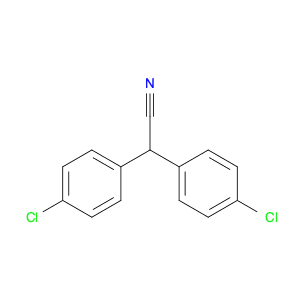
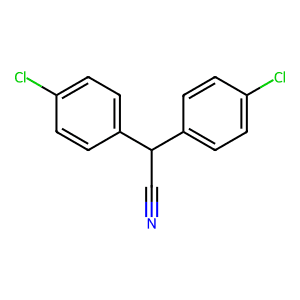
:bis(4-chlorophenyl)acetonitrile
Description:
Bis(4-chlorophenyl)acetonitrile, with the CAS number 20968-04-1, is an organic compound characterized by its structure, which features two 4-chlorophenyl groups attached to a central acetonitrile moiety. This compound is typically a white to off-white solid at room temperature and is known for its relatively low solubility in water, but it may dissolve in organic solvents such as acetone or dichloromethane. The presence of the chlorophenyl groups contributes to its chemical stability and potential reactivity, making it of interest in various chemical applications, including pharmaceuticals and agrochemicals. Its acetonitrile functional group provides polar characteristics, which can influence its interactions in chemical reactions. Additionally, bis(4-chlorophenyl)acetonitrile may exhibit biological activity, although specific biological properties would depend on the context of its use. As with many organic compounds, handling should be done with care, considering potential toxicity and environmental impact.
Formula:C14H9Cl2N
InChI:InChI=1/C14H9Cl2N/c15-12-5-1-10(2-6-12)14(9-17)11-3-7-13(16)8-4-11/h1-8,14H
SMILES:c1cc(ccc1C(C#N)c1ccc(cc1)Cl)Cl
Synonyms:- Benzeneacetonitrile, 4-chloro-alpha-(4-chlorophenyl)-
- Bis(P-Chlorophenyl)Acetonitrile
Sort by
Purity (%)
0
100
|
0
|
50
|
90
|
95
|
100
Found 4 products.
Benzeneacetonitrile, 4-chloro-α-(4-chlorophenyl)-
CAS:Formula:C14H9Cl2NPurity:97%Color and Shape:SolidMolecular weight:262.13402,2-Bis(4-chlorophenyl)acetonitrile
CAS:2,2-Bis(4-chlorophenyl)acetonitrilePurity:97%Molecular weight:262.14g/mol2,2-Bis(4-chlorophenyl)acetonitrile
CAS:2,2-Bis(4-chlorophenyl)acetonitrile (PCN) is a colorless crystalline solid that can be prepared by alkylation of phenol with chloroacetonitrile. It has been used as a pesticide and chemical intermediate in the production of other chemicals. PCN is an isomer of 2,4-dichlorophenol and is widely distributed in the environment. PCN has shown mutagenic activity in the Ames test and was detected in particulate matter at levels up to 2.5 μg/m3. This compound can be found in nature as a result of its use as a pesticide or chemical intermediate.
Formula:C14H9Cl2NPurity:Min. 95%Molecular weight:262.13 g/mol