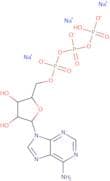
CAS 20978-32-9
:Adenosine 5'-(tetrahydrogen triphosphate), trisodium salt
Description:
Adenosine 5'-(tetrahydrogen triphosphate), trisodium salt, commonly referred to as ATP (adenosine triphosphate), is a nucleotide that plays a crucial role in cellular energy transfer. It consists of an adenosine molecule bonded to three phosphate groups, with the trisodium salt form indicating the presence of three sodium ions that balance the negative charges of the phosphate groups. ATP is highly soluble in water, making it readily available for biochemical reactions. It serves as the primary energy currency of the cell, providing energy for various biological processes, including muscle contraction, nerve impulse propagation, and biosynthesis. The molecule is characterized by its high-energy phosphate bonds, particularly the terminal phosphate bond, which, when hydrolyzed, releases energy that can be harnessed by enzymes and other cellular machinery. Additionally, ATP is involved in signaling pathways and acts as a substrate for kinases in phosphorylation reactions. Its stability and reactivity are essential for its function in metabolism and cellular regulation.
Formula:C10H16N5O13P3Na
Sort by
Purity (%)
0
100
|
0
|
50
|
90
|
95
|
100
Found 1 products.
Adenosine 5'-triphosphate trisodium salt
CAS:<p>ATP is an important molecule in the body that is involved in a number of cellular processes, including energy production and transmission. It has been shown to be tumorigenic and is found at high levels in plasma membranes and muscle cells. ATP binds to the adenylate cyclase enzyme in the cell membrane and stimulates its activity, which increases intracellular levels of cyclic AMP (cAMP). Cyclic AMP activates protein kinase A, which phosphorylates proteins, leading to a cascade of reactions that result in cellular changes. ATP also has pharmacological effects on the plasma membrane by increasing its permeability to certain ions such as potassium ions. This leads to an increase in the rate of depolarization of the cell membrane, which causes an influx of calcium ions into the cell.</p>Formula:C10H15N5O13P3Na3Purity:Min. 95%Molecular weight:575.14 g/mol