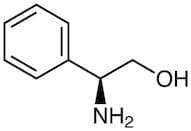
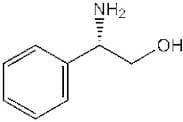
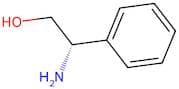
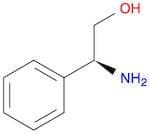
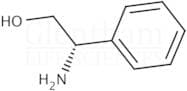
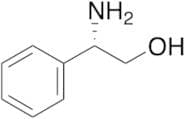
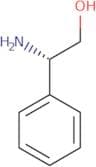
CAS 20989-17-7
:(+)-Phenylglycinol
Description:
(+)-Phenylglycinol, with the CAS number 20989-17-7, is an organic compound characterized by its chiral nature, existing as a single enantiomer. It features a phenyl group attached to a glycinol structure, which includes both an amino group and a hydroxyl group. This compound is typically a colorless to pale yellow liquid or solid, depending on its form and purity. It is soluble in water and organic solvents, making it versatile for various applications. (+)-Phenylglycinol is often utilized in the synthesis of pharmaceuticals and agrochemicals, as well as in the production of chiral intermediates due to its optical activity. Its ability to form hydrogen bonds and participate in various chemical reactions makes it valuable in organic synthesis. Additionally, it may exhibit biological activity, contributing to its relevance in medicinal chemistry. Safety data should be consulted for handling and usage, as with any chemical substance, to ensure proper precautions are taken.
Formula:C8H11NO
InChI:InChI=1S/C8H11NO/c9-8(6-10)7-4-2-1-3-5-7/h1-5,8,10H,6,9H2/t8-/m1/s1
InChI key:InChIKey=IJXJGQCXFSSHNL-MRVPVSSYSA-N
SMILES:[C@H](CO)(N)C1=CC=CC=C1
Synonyms:- (+)-Phenylglycinol
- (+)-α-Phenylglycinol
- (1S)-2-Amino-2-phenylethanol
- (1S)-2-Hydroxy-1-phenylethylamine
- (2R)-2-amino-2-phenylethanol
- (2S)-2-Amino-2-phenyl-1-ethanol
- (2S)-2-Amino-2-phenylethan-1-ol
- (2S)-2-Phenyl-2-aminoethanol
- (2S)-2-amino-2-phenylethanol
- (2S)-Phenylglycinol
- (S)-(+)-2-Phenylglycinol
- (S)-1-Phenyl-2-hydroxyethylamine
- (S)-2-Amino-2-phenylethan-1-ol
- (S)-2-Phenylethanolamine
- (S)-Phenylglycinol
- (S)-α-Aminophenylethanol
- (S)-β-Aminobenzeneethanol
- (βS)-β-Aminobenzeneethanol
- 2-Amino-2-Phenylethanol
- <span class="text-smallcaps">L</span>-Phenylglycinol
- <span class="text-smallcaps">L</span>-α-Phenylglycinol
- <span class="text-smallcaps">L</span>-β-Aminophenethyl alcohol
- Benzeneethanol, β-amino-, (S)-
- Benzeneethanol, β-amino-, (βS)-
- L-2-phenylglycinol
- Phenethyl alcohol, β-amino-, <span class="text-smallcaps">L</span>-
- R-Phenylglycinol
- [(S)-2-Hydroxy-1-phenylethyl]amine
- See more synonyms
Sort by
Purity (%)
0
100
|
0
|
50
|
90
|
95
|
100
Found 8 products.
(S)-(+)-2-Phenylglycinol
CAS:Formula:C8H11NOPurity:>97.0%(GC)(T)Color and Shape:White to Orange to Green powder to crystalMolecular weight:137.18(S)-(+)-2-Phenylglycinol, 98+%
CAS:(S)-(+)-2-Phenylglycinol is used in the synthesis of chiral, unsymmetrical bisoxazolines. It is used as a reagent for the resolution of acids via the easily hydrolyzed amides. This Thermo Scientific Chemicals brand product was originally part of the Alfa Aesar product portfolio. Some documentation aFormula:C8H11NOPurity:98+%Color and Shape:Powder or crystalline powder, White to pale yellowMolecular weight:137.18(2S)-2-Amino-2-phenylethan-1-ol
CAS:(2S)-2-Amino-2-phenylethan-1-olFormula:C8H11NOPurity:≥95%Color and Shape:SolidMolecular weight:137.17904Ref: IN-DA0032G2
10g20.00€5g21.00€25g25.00€100g46.00€500g111.00€1kg156.00€10kg1,051.00€25kg2,601.00€50kg5,196.00€L-Phenylglycinol
CAS:L-phenylglycinol is a chiral compound that is synthesized by the reaction of phenylglycinol with hydroxide solution in the presence of an asymmetric synthesis catalyst. It is used as a precursor to chiral amides and aziridines, which are important for addressing the need for enantiopure compounds. The reaction mechanism involves nucleophilic substitution at the amino function, which can be catalyzed by copper complexes in solution. This reaction can also be monitored using liquid chromatography methods.
Formula:C8H11NOPurity:Min. 95%Color and Shape:White PowderMolecular weight:137.18 g/mol