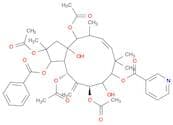
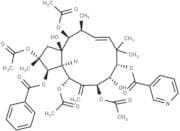
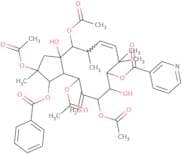
CAS 210108-89-7
:(2R,3R,3aS,4R,6S,7S,8S,10E,12S,13S,13aR)-2,4,6,13-Tetrakis(acetyloxy)-3-(benzoyloxy)-2,3,3a,4,5,6,7,8,9,12,13,13a-dodecahydro-7,13a-dihydroxy-2,9,9,12-tetramethyl-5-methylene-1H-cyclopentacyclododecen-8-yl 3-pyridinecarboxylate
Description:
The chemical substance with the name "(2R,3R,3aS,4R,6S,7S,8S,10E,12S,13S,13aR)-2,4,6,13-Tetrakis(acetyloxy)-3-(benzoyloxy)-2,3,3a,4,5,6,7,8,9,12,13,13a-dodecahydro-7,13a-dihydroxy-2,9,9,12-tetramethyl-5-methylene-1H-cyclopentacyclododecen-8-yl 3-pyridinecarboxylate" and CAS number "210108-89-7" is a complex organic compound characterized by its intricate stereochemistry and multiple functional groups. It features a tetrakis(acetyloxy) moiety, indicating the presence of four acetoxy groups, and a benzoyloxy group, which suggests aromatic characteristics. The compound is a derivative of a dodecahydro structure, indicating a saturated cyclic framework with multiple rings. The presence of hydroxyl groups contributes to its potential reactivity and solubility in polar solvents. Additionally, the inclusion of a pyridinecarboxylate suggests potential biological activity, possibly as a ligand or in medicinal chemistry applications. Overall, this compound's structural complexity and functional diversity may confer unique properties, making it of interest in various fields, including pharmaceuticals and organic synthesis.
Formula:C41H49NO14
InChI:InChI=1S/C41H49NO14/c1-22-17-18-39(7,8)36(55-38(49)29-16-13-19-42-20-29)31(47)33(52-25(4)44)23(2)32(51-24(3)43)30-35(54-37(48)28-14-11-10-12-15-28)40(9,56-27(6)46)21-41(30,50)34(22)53-26(5)45/h10-20,22,30-36,47,50H,2,21H2,1,3-9H3/b18-17+/t22-,30-,31+,32-,33-,34-,35+,36+,40+,41+/m0/s1
InChI key:InChIKey=GLYDSECXZWCLMS-RWMROPJHSA-N
SMILES:O[C@@]12[C@]([C@@H](OC(=O)C3=CC=CC=C3)[C@@](OC(C)=O)(C)C1)([C@@H](OC(C)=O)C(=C)[C@H](OC(C)=O)[C@@H](O)[C@@H](OC(=O)C=4C=CC=NC4)C(C)(C)\C=C\[C@H](C)[C@@H]2OC(C)=O)[H]
Synonyms:- (2R,3R,3aS,4R,6S,7S,8S,10E,12S,13S,13aR)-2,4,6,13-Tetrakis(acetyloxy)-3-(benzoyloxy)-2,3,3a,4,5,6,7,8,9,12,13,13a-dodecahydro-7,13a-dihydroxy-2,9,9,12-tetramethyl-5-methylene-1H-cyclopentacyclododecen-8-yl 3-pyridinecarboxylate
- 3-Pyridinecarboxylic acid, (2R,3R,3aS,4R,6S,7S,8S,10E,12S,13S,13aR)-2,4,6,13-tetrakis(acetyloxy)-3-(benzoyloxy)-2,3,3a,4,5,6,7,8,9,12,13,13a-dodecahydro-7,13a-dihydroxy-2,9,9,12-tetramethyl-5-methylene-1H-cyclopentacyclododecen-8-yl ester
- Jatrophane 5
Sort by
Purity (%)
0
100
|
0
|
50
|
90
|
95
|
100
Found 3 products.
Jatrophane 5
CAS:Jatrophane 5 surpasses R(+)-verapamil and tariquidar in inhibiting P-gp in MDR colorectal cells (DLD1-TxR).Formula:C41H49NO14Purity:98%Color and Shape:SolidMolecular weight:779.8362,5,7,14-Tetraacetoxy-3-benzoyloxy-8,15-dihydroxy-9-nicotinoyloxyjatropha-6(17),11E-diene
CAS:2,5,7,14-Tetraacetoxy-3-benzoyloxy-8,15-dihydroxy-9-nicotinoyloxyjatropha-6(17),11E-diene is a specialized diterpenoid ester compound, which is derived from the plant Jatropha. This compound belongs to the class of biochemicals known for their intricate molecular structure and potential biological activities. The source of this compound, Jatropha, is a genus of flowering plants in the spurge family, Euphorbiaceae. Extracted primarily from Jatropha species, these diterpenoids are known for their diverse pharmacological properties.Formula:C41H49NO14Purity:Min. 95%Molecular weight:779.8 g/mol