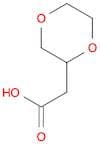
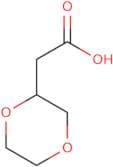
CAS 210647-03-3
:2-(1,4-dioxan-2-yl)acetic acid
Description:
2-(1,4-Dioxan-2-yl)acetic acid is an organic compound characterized by its dioxane ring structure, which contributes to its unique chemical properties. The presence of the acetic acid functional group imparts acidic characteristics, allowing it to participate in various chemical reactions, such as esterification and amidation. This compound is typically a colorless to pale yellow liquid or solid, depending on its purity and specific conditions. It is soluble in polar solvents like water and alcohols, which enhances its utility in various applications, including pharmaceuticals and chemical synthesis. The dioxane moiety can provide stability and influence the compound's reactivity, making it a valuable intermediate in organic synthesis. Additionally, the compound may exhibit biological activity, which could be of interest in medicinal chemistry. Safety considerations should be taken into account, as with many organic compounds, including proper handling and storage to avoid potential hazards. Overall, 2-(1,4-dioxan-2-yl)acetic acid is a versatile compound with significant implications in both industrial and research settings.
Sort by
Purity (%)
0
100
|
0
|
50
|
90
|
95
|
100
Found 4 products.
2-(1,4-Dioxan-2-yl)acetic acid
CAS:Formula:C6H10O4Purity:95%Color and Shape:LiquidMolecular weight:146.14121,4-dioxane-2-acetic acid
CAS:1,4-dioxane-2-acetic acid is a polar molecule with an acid functional group. It can be extracted from hexanoic acid or synthesized by the reaction of isophorone and nitrosurea. It reacts with proton transfer to form a hexanoyl anion, which is then hydrolyzed to form the hexanoic acid product. The rate of this reaction depends on the concentration of 1,4-dioxane-2-acetic acid and proton donor. This reaction mechanism is characterized by its kinetic constants, which are temperature dependent. 1,4-dioxane-2-acetic acid has been used in the synthesis of hexanoic acid derivatives that are used as food additives and preservatives.Formula:C6H10O4Purity:Min. 95%Molecular weight:146.14 g/mol