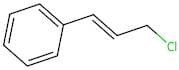
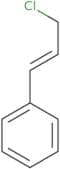
CAS 21087-29-6
:Cinnamyl chloride
Description:
Cinnamyl chloride, with the CAS number 21087-29-6, is an organic compound characterized by its aromatic structure, which includes a cinnamyl group (derived from cinnamic acid) attached to a chlorine atom. It typically appears as a colorless to pale yellow liquid with a sweet, spicy odor reminiscent of cinnamon. Cinnamyl chloride is known for its reactivity, particularly in nucleophilic substitution reactions, where the chlorine atom can be replaced by various nucleophiles. This compound is soluble in organic solvents such as ether and alcohol but has limited solubility in water. It is primarily used in organic synthesis, particularly in the production of various pharmaceuticals, fragrances, and agrochemicals. Due to its reactive nature, cinnamyl chloride should be handled with care, as it can be irritating to the skin, eyes, and respiratory system. Proper safety precautions, including the use of personal protective equipment, are essential when working with this compound in a laboratory or industrial setting.
Formula:C9H9Cl
InChI:InChI=1/C9H9Cl/c10-8-4-7-9-5-2-1-3-6-9/h1-7H,8H2
SMILES:c1ccc(cc1)C=CCCl
Synonyms:- (3-Chloro-1-propenyl)benzene
- 3-Chloro-1-phenyl-1-propene
- (3-Chloroprop-1-Enyl)Benzene
- (3-Chloroprop-1-En-1-Yl)Benzene
Sort by
Purity (%)
0
100
|
0
|
50
|
90
|
95
|
100
Found 4 products.
Benzene, [(1E)-3-chloro-1-propen-1-yl]-
CAS:Formula:C9H9ClPurity:95%Color and Shape:LiquidMolecular weight:152.6208(E)-(3-Chloroprop-1-En-1-Yl)Benzene
CAS:(E)-(3-Chloroprop-1-En-1-Yl)BenzenePurity:95%Molecular weight:152.62g/molCINNAMYL CHLORIDE
CAS:The asymmetric synthesis of cinnamyl chloride is achieved using a palladium-catalyzed coupling reaction. Cinnamyl chloride is a chiral compound that has been shown to have anti-inflammatory properties and inhibit acetylcholinesterase (AChE) activity. The enzyme inhibition mechanism of cinnamyl chloride is not well-understood, but it may be attributed to the allylation of the nitrogen atoms in the molecule. Cinnamyl chloride inhibits AChE by binding to its active site, which prevents the hydrolysis of acetylcholine, an important neurotransmitter for memory and learning. This leads to increased levels of acetylcholine in the brain and increases neuron activity.Formula:C9H9ClPurity:Min. 95%Molecular weight:152.62 g/mol
![Benzene, [(1E)-3-chloro-1-propen-1-yl]-](/_next/image/?url=https%3A%2Fstatic.cymitquimica.com%2Fproducts%2FIN%2Fthumb%2FDA002L0S.jpg&w=3840&q=75)