CAS 211057-02-2
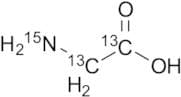
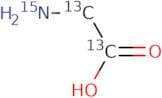
:glycine-13C2-15N
Description:
Glycine-13C2-15N, with the CAS number 211057-02-2, is a stable isotope-labeled form of glycine, which is the simplest amino acid and a fundamental building block of proteins. In this compound, the carbon atoms are isotopically enriched with carbon-13 (13C), and one of the nitrogen atoms is enriched with nitrogen-15 (15N), making it useful in various scientific applications, particularly in metabolic studies and tracer experiments. The presence of these isotopes allows researchers to track the incorporation and metabolism of glycine in biological systems using techniques such as nuclear magnetic resonance (NMR) spectroscopy and mass spectrometry. Glycine itself is a non-polar, neutral amino acid that plays a crucial role in protein synthesis and serves as a neurotransmitter in the central nervous system. The isotopic labeling enhances its utility in research, particularly in studies involving protein dynamics, metabolic pathways, and the understanding of nitrogen and carbon cycling in biological systems.
Formula:C2H5NO2
Synonyms:- GLYCINE-13C2-15N, 99 ATOM % 13C, 99 ATOM % 15N
- 2-AMinoacetic Acid-13C2,15N
- GLYCINE-13C2-15N
- [13C2,15N]-Glycine
- Aminoacetic acid-13C2,15N
- DHMQDGOQFOQNFH-VMIGTVKRSA-N
- Aminoethanoic acid-13C2,15N
- 98+atom%13c98+atom%15n
- GLYCINE (U-13C2, 15N)
Sort by
Purity (%)
0
100
|
0
|
50
|
90
|
95
|
100
Found 4 products.
Glycine-13C2,15N
CAS:Applications Labelled analogue of Glycine, a non-essential amino acid for human development. Glycine is an inhibitory neurotransmitter in spinal cord, allosteric regulator of NMDA receptors.
References Scott, D. et al.: J. Neurosci., 21, 3063 (2001); Laube, B. et al.: Neuropharmacology, 47, 994 (2004); Papadakis, M. et al.: J. Biol. Chem., 279, 14703 (2004); Chen, P. et al.: Mol. Pharmacol., 67, 1470 (2005); Wolosker, H. et al.: Mol. Neurobiol., 36, 152 (2007);Formula:C2H515NO2Color and Shape:NeatMolecular weight:78.05(13C2,15N)Glycine
CAS:Glycine is an amino acid that is found in the human blood. It is a non-essential amino acid and has a high level of stability. Glycine can be used as an untreated control to measure the stability of other compounds; it has been shown to be stable for up to six months at room temperature and for more than one year when frozen. Glycine is not found in any food sources, but can be synthesized by the body from other amino acids. The following are sample product descriptions: Rifapentine Rifapentine is an anti-tuberculosis drug that belongs to the class of rifamycins. It is the most active of the rifamycins for the treatment of tuberculosis. Rifapentine inhibits bacterial growth by binding to DNA-dependent RNA polymerase, thereby preventing transcription and replication. The high frequency of human activity has been shown using a patch-clamp technique on humanPurity:Min. 95%Color and Shape:PowderMolecular weight:77.99 g/mol