![N2,N6-Bis[(phenylmethoxy)carbonyl]-L-lysine 2,5-dioxo-1-pyrrolidinyl ester](/_next/image/?url=https%3A%2Fstatic.cymitquimica.com%2Fcas-image%2Fthumb-webp%2F104921-z-lys-z-osu.webp&w=3840&q=75)
CAS 21160-83-8
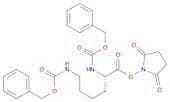
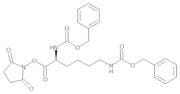
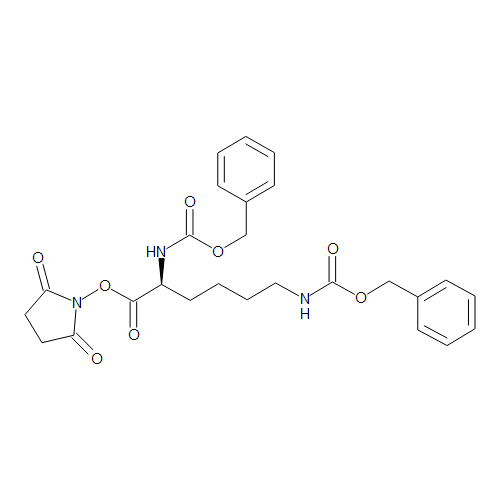
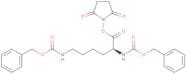
:N2,N6-Bis[(phenylmethoxy)carbonyl]-L-lysine 2,5-dioxo-1-pyrrolidinyl ester
Description:
N2,N6-Bis[(phenylmethoxy)carbonyl]-L-lysine 2,5-dioxo-1-pyrrolidinyl ester, with CAS number 21160-83-8, is a synthetic compound that belongs to the class of amino acid derivatives. This substance features a lysine backbone modified with two phenylmethoxycarbonyl groups, enhancing its lipophilicity and potentially its bioavailability. The presence of the pyrrolidinyl ester moiety suggests that it may exhibit unique reactivity and stability characteristics, making it of interest in pharmaceutical applications. The compound is likely to be soluble in organic solvents, while its solubility in water may be limited due to the bulky phenyl groups. Its structure indicates potential for interactions with biological targets, which could be explored for therapeutic purposes. As with many synthetic compounds, safety and handling precautions should be observed, as the specific toxicity and environmental impact of this compound would need to be assessed through appropriate studies. Overall, this compound exemplifies the complexity and versatility of amino acid derivatives in medicinal chemistry.
Formula:C26H29N3O8
InChI:InChI=1/C26H29N3O8/c30-22-14-15-23(31)29(22)37-24(32)21(28-26(34)36-18-20-11-5-2-6-12-20)13-7-8-16-27-25(33)35-17-19-9-3-1-4-10-19/h1-6,9-12,21H,7-8,13-18H2,(H,27,33)(H,28,34)
InChI key:InChIKey=LHOAUCZIIQFZMI-NRFANRHFSA-N
SMILES:O(C([C@@H](NC(OCC1=CC=CC=C1)=O)CCCCNC(OCC2=CC=CC=C2)=O)=O)N3C(=O)CCC3=O
Synonyms:- (2,5-Dioxopyrrolidin-1-yl) (2S)-2,6-bis(phenylmethoxycarbonylamino)hexanoate
- 2,5-dioxopyrrolidin-1-yl N~2~,N~6~-bis[(benzyloxy)carbonyl]lysinate
- <span class="text-smallcaps">L</span>-Lysine, N<sup>2</sup>,N<sup>6</sup>-bis[(phenylmethoxy)carbonyl]-, 2,5-dioxo-1-pyrrolidinyl ester
- Carbamic acid, [(1S)-1-[[(2,5-dioxo-1-pyrrolidinyl)oxy]carbonyl]-1,5-pentanediyl]bis-, bis(phenylmethyl) ester
- Carbamic acid, [1-[[(2,5-dioxo-1-pyrrolidinyl)oxy]carbonyl]-1,5-pentanediyl]bis-, bis(phenylmethyl) ester, (S)-
- N<sup>2</sup>,N<sup>6</sup>-Bis[(phenylmethoxy)carbonyl]-<span class="text-smallcaps">L</span>-lysine 2,5-dioxo-1-pyrrolidinyl ester
- N<sup>α</sup>,N<sup>ε</sup>-Dibenzyloxycarbonyl-<span class="text-smallcaps">L</span>-lysine N-hydroxysuccinimide ester
- NSC 250409
- Succinimide, N-[(N<sup>2</sup>,N<sup>6</sup>-dicarboxy-<span class="text-smallcaps">L</span>-lysyl)oxy]-, dibenzyl ester
- Z-Lys(Z)-OSu
- na,N-epsilon-di-cbz-L-lysine N-*hydroxysuccinimid
- Succinimide, N-[(N2,N6-dicarboxy-L-lysyl)oxy]-, dibenzyl ester
- N2,N6-Bis[(phenylmethoxy)carbonyl]-L-lysine 2,5-dioxo-1-pyrrolidinyl ester
- L-Lysine, N2,N6-bis[(phenylmethoxy)carbonyl]-, 2,5-dioxo-1-pyrrolidinyl ester
- 2,5-Dioxopyrrolidin-1-yl (2S)-2,6-Bis(benzyloxycarbonylamino)hexanoate (N,N'-Bis(benzyloxycarbonyl)-L-lysine N-Succinimidyl Ester)
- Nα,ε-Bis-Z-L-lysineN-hydroxysuccinimide ester99%
- N-ALPHA,EPSILON-BIS-Z-L-LYSINE N-HYDROXYSUCCINIMIDE ESTER
- Z-LYS-OSU
- Z-LYSINE(Z)-OSU
- Z-LYL(Z)-OSU
- N-ALPHA,N-EPSILON-DI-Z-L-LYSINE HYDROXYSUCCINIMIDE ESTER
- N-ALPHA, N-EPSILON-DIBENZYLOXYCARBONYL-L-LYSINE N-HYDROXYSUCCINIMIDE ESTER
- Nα,ε-Bis-Z-L-lysine N-hydroxysuccinimide ester
- Z-L-LYSINE N-HYDROXYSUCCINIMIDE ESTER
- nα,nε-di-z-l-lysine hydroxysuccinimide ester
- Cbz-lys(z)-osu
- See more synonyms
Sort by
Purity (%)
0
100
|
0
|
50
|
90
|
95
|
100
Found 8 products.
Nα,ε-Bis-Z-L-lysine N-hydroxysuccinimide ester
CAS:Formula:C26H29N3O8Purity:95%Color and Shape:SolidMolecular weight:511.5238Z-Lys(z)-osu
CAS:Controlled ProductApplications Z-Lys(z)-osu
Formula:C26H29N3O8Color and Shape:NeatMolecular weight:511.52N-alpha,epsilon-bis-Z-L-Lysine N-hydroxysuccinimide ester
CAS:N-alpha,epsilon-bis-Z-L-Lysine N-hydroxysuccinimide ester is a methyl ester of the amino acid Lysine. This drug has been shown to have antinociceptive effects in animal models and may be useful for the treatment of inflammatory pain. The active conformation of this drug is dependent on the presence of hydroxybenzimidazole (HOBt). In the absence of HOBt, the compound does not have any activity. Acetylation or amidation may also affect its activity. The reaction with nitric acid yields a nitro derivative, which can be reduced back to the original compound by catalytic hydrogenation using palladium on carbon. A carboxylic acid group at the amino terminus can be converted to an amide or amido group by treatment with an appropriate reagent such as acetonitrile. This drug binds to a catalytic site onFormula:C26H29N3O8Purity:Min. 95%Color and Shape:White Off-White PowderMolecular weight:511.52 g/molZ-Lys(Z)-OSu
CAS:Bachem ID: 4000136.
Formula:C26H29N3O8Purity:> 98%Color and Shape:White PowderMolecular weight:511.53