CAS 21182-07-0
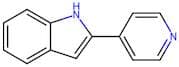
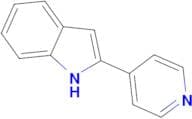
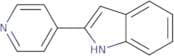
:2-pyridin-4-yl-1H-indole
Description:
2-Pyridin-4-yl-1H-indole, with the CAS number 21182-07-0, is an organic compound characterized by its indole and pyridine moieties. This compound features a bicyclic structure, where the indole ring is fused with a pyridine ring, contributing to its unique chemical properties. It typically exhibits a solid state at room temperature and is known for its potential biological activity, making it of interest in medicinal chemistry and drug development. The presence of both nitrogen-containing rings can influence its reactivity, solubility, and interaction with biological targets. Additionally, 2-pyridin-4-yl-1H-indole may participate in various chemical reactions, such as electrophilic substitutions or coordination with metal ions, due to the electron-rich nature of the indole nitrogen and the pyridine nitrogen. Its derivatives and analogs are often explored for their pharmacological properties, including anti-cancer and anti-inflammatory activities. As with many organic compounds, proper handling and safety measures should be observed due to potential toxicity or reactivity.
Formula:C13H10N2
InChI:InChI=1/C13H10N2/c1-2-4-12-11(3-1)9-13(15-12)10-5-7-14-8-6-10/h1-9,15H
SMILES:c1ccc2c(c1)cc(c1ccncc1)[nH]2
Synonyms:- 1H-indole, 2-(4-pyridinyl)-
- 2-(4-Pyridinyl)-1H-indol
- 2-(4-Pyridinyl)-1H-indole
Sort by
Purity (%)
0
100
|
0
|
50
|
90
|
95
|
100
Found 3 products.
2-(Pyridin-4-yl)-1H-indole
CAS:2-(Pyridin-4-yl)-1H-indoleFormula:C13H10N2Purity:95%Color and Shape: faint brown powderMolecular weight:194.23g/mol2-(Pyridin-4-yl)-1H-indole
CAS:2-(Pyridin-4-yl)-1H-indole is an antibiotic that functions as a proton pump inhibitor. It has been shown to be effective against methicillin-resistant Staphylococcus aureus (MRSA) and methicillin-sensitive Staphylococcus aureus (MSSA). 2-(Pyridin-4-yl)-1H-indole has been shown to inhibit the growth of MRSA by cleaving bonds in peptidoglycan, which is an essential component of the bacterial cell wall. Although this drug has not yet been tested in humans, it could have clinical relevance because it inhibits the production of penicillinase, which is a major mechanism of resistance to beta lactams.
Formula:C13H10N2Purity:Min. 95%Molecular weight:194.24 g/mol