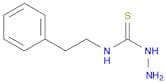
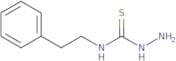
CAS 21198-23-2
:4-(b-Phenethyl)-3-thiosemicarbazide
Description:
4-(b-Phenethyl)-3-thiosemicarbazide is an organic compound characterized by its thiosemicarbazide functional group, which contains a sulfur atom bonded to a carbonyl carbon. This compound features a phenethyl group, which contributes to its aromatic properties and potential biological activity. Typically, thiosemicarbazides are known for their ability to form coordination complexes with metal ions, making them of interest in coordination chemistry and medicinal applications. The presence of the phenethyl moiety may enhance lipophilicity, influencing the compound's solubility and permeability in biological systems. Additionally, thiosemicarbazides are often studied for their antimicrobial, antifungal, and anticancer properties, suggesting potential therapeutic uses. The compound's reactivity can be attributed to the presence of the thioamide functional group, which can participate in various chemical reactions, including nucleophilic substitutions and condensation reactions. Overall, 4-(b-Phenethyl)-3-thiosemicarbazide exhibits a combination of structural features that may confer unique chemical and biological properties, warranting further investigation in both synthetic and medicinal chemistry contexts.
Formula:C9H13N3S
InChI:InChI=1/C9H13N3S/c10-12-9(13)11-7-6-8-4-2-1-3-5-8/h1-5H,6-7,10H2,(H2,11,12,13)
SMILES:c1ccc(cc1)CCN=C(NN)S
Synonyms:- N-(2-phenylethyl)hydrazinecarbothioamide
Sort by
Purity (%)
0
100
|
0
|
50
|
90
|
95
|
100
Found 4 products.
N-(1-Phenylethyl)hydrazinecarbothioamide
CAS:Formula:C9H13N3SColor and Shape:SolidMolecular weight:195.28464-(β-Phenethyl)-3-thiosemicarbazide
CAS:4-(β-Phenethyl)-3-thiosemicarbazide
Molecular weight:195.28462g/molN-(1-Phenylethyl)hydrazinecarbothioamide
CAS:N-(1-Phenylethyl)hydrazinecarbothioamide (HZPCA) is a corrosion inhibitor that is used in acid solutions such as hydrochloric acid, nitric acid, phosphoric acid, and sulfuric acid. It is an organic compound that has been shown to be active against certain metal ions at the adsorption sites. The efficiency of HZPCA adsorption for different metal ions depends on the pH of the solution. HZPCA also has potent inhibitory effects on the corrosion process by reacting with the metal oxide film on metal surfaces and forming an insoluble hydrazine complex. This complex reduces further corrosion by blocking oxygen diffusion to the metal surface.Formula:C9H13N3SPurity:Min. 95%Molecular weight:195.29 g/mol