CAS 212755-81-2
:6-(1-formyl-2-oxoethyl)pyridine-3-carboxylic acid
Description:
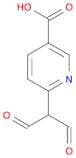
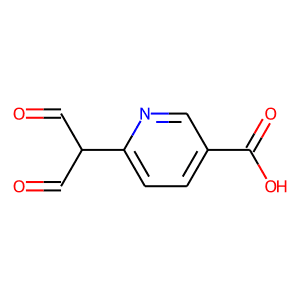
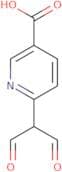
6-(1-formyl-2-oxoethyl)pyridine-3-carboxylic acid, with the CAS number 212755-81-2, is a chemical compound characterized by its pyridine ring structure, which is a six-membered aromatic ring containing one nitrogen atom. This compound features a carboxylic acid functional group, contributing to its acidic properties, and an aldehyde group due to the formyl substituent. The presence of the keto group (2-oxo) indicates that it has a carbonyl functionality, which can participate in various chemical reactions, such as nucleophilic addition. The compound's structure suggests potential applications in medicinal chemistry, particularly in the development of pharmaceuticals, due to the reactivity of the carbonyl groups and the ability to form hydrogen bonds. Additionally, the pyridine moiety may enhance biological activity and solubility in polar solvents. Overall, this compound's unique functional groups and aromatic characteristics make it a subject of interest for further research and potential applications in various chemical fields.
Formula:C9H7NO4
InChI:InChI=1/C9H7NO4/c11-4-7(5-12)8-2-1-6(3-10-8)9(13)14/h1-5,7H,(H,13,14)
SMILES:c1cc(C(C=O)C=O)ncc1C(=O)O
Synonyms:- 3-Pyridinecarboxylic acid, 6-(1-formyl-2-oxoethyl)-
- 6-(1,3-Dioxopropan-2-yl)nicotinic acid
Sort by
Purity (%)
0
100
|
0
|
50
|
90
|
95
|
100
Found 4 products.
2-(3-Hydroxycarbonyl-6-pyridyl)malondialdehyde
CAS:Formula:C9H7NO4Purity:95.0%Color and Shape:Crystalline PowderMolecular weight:193.1586-(1,3-Dioxoprop-2-yl)nicotinic acid
CAS:6-(1,3-Dioxoprop-2-yl)nicotinic acidPurity:95%Color and Shape:Pale Orange PowderMolecular weight:193.16g/mol2-(3-Hydroxycarbonyl-6-pyridyl)malondialdehyde
CAS:2-(3-Hydroxycarbonyl-6-pyridyl)malondialdehyde is a versatile building block that can be used for the synthesis of complex compounds, as well as for use in research and development. This chemical is a high quality compound that can be used to produce a variety of useful products. It has been shown to have properties that make it an excellent reagent, scaffold, and reaction component.Formula:C9H7NO4Purity:Min. 95%Color and Shape:PowderMolecular weight:193.16 g/mol