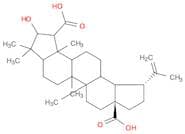
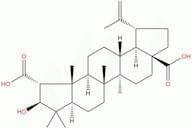
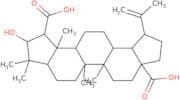
CAS 21302-79-4
:Ceanothic acid
Description:
Ceanothic acid, with the CAS number 21302-79-4, is a naturally occurring organic compound classified as a fatty acid. It is primarily derived from the plant genus Ceanothus, commonly known as California lilac. This compound is characterized by its long hydrocarbon chain, which contributes to its hydrophobic properties. Ceanothic acid typically exhibits a carboxylic acid functional group, which imparts acidic characteristics and allows for potential reactivity in various chemical processes. It is known for its potential applications in the fields of biochemistry and pharmacology, particularly due to its biological activity and possible therapeutic effects. Additionally, ceanothic acid may play a role in plant defense mechanisms, contributing to the plant's resilience against herbivores and pathogens. Its structural features and biological significance make it a subject of interest in both natural product chemistry and ecological studies. However, detailed studies on its specific properties and applications are still ongoing, highlighting the need for further research in this area.
Formula:C30H46O5
InChI:InChI=1S/C30H46O5/c1-16(2)17-10-13-30(25(34)35)15-14-27(5)18(21(17)30)8-9-20-28(27,6)12-11-19-26(3,4)23(31)22(24(32)33)29(19,20)7/h17-23,31H,1,8-15H2,2-7H3,(H,32,33)(H,34,35)/t17-,18+,19-,20-,21+,22+,23-,27+,28+,29-,30-/m0/s1
InChI key:InChIKey=WLCHQSHZHFLMJH-VILVJDKQSA-N
SMILES:C[C@@]12[C@@]3([C@](C)([C@@]4(C)[C@](CC3)([C@@]5([C@@](C(O)=O)(CC4)CC[C@H]5C(C)=C)[H])[H])CC[C@]1(C(C)(C)[C@@H](O)[C@@H]2C(O)=O)[H])[H]
Synonyms:- (2a,3b)-3-Hydroxy-A(1),28-dinorlup-20(29)-ene-2,17-dicarboxylic acid
- (3β,3′β,4α,4′α,5β,8α,9β,10α,13α,14β,15β)-Tetrahydro-4′-hydroxy-4,5′,5′,9-tetramethyl-15-(1-methylethenyl)-3′H-cyclopenta[3,4]-18-norandrost-3-ene-3′,13-dicarboxylic acid
- 21302-79-4
- 2α-Carboxy-3β-hydroxy-A(1)-norlup-20(29)-en-28-oic acid
- 3′H-Cyclopenta[3,4]-18-norandrost-3-ene-3′,13-dicarboxylic acid, tetrahydro-4′-hydroxy-4,5′,5′,9-tetramethyl-15-(1-methylethenyl)-, (3β,3′β,4α,4′α,5β,8α,9β,10α,13α,14β,15β)-
- A(1),28-Dinorlup-20(29)-ene-2,17-dicarboxylic acid, 3-hydroxy-, (2α,3β)-
- A(1)-Norlup-20(29)-en-28-oic acid, 2α-carboxy-3β-hydroxy-
- Ceanothic acid
- Emmolic Acid
- dicyclopenta[a,i]phenanthrene-1,7a(1H)-dicarboxylic acid, octadecahydro-2-hydroxy-3,3,5a,5b,12b-pentamethyl-10-(1-methylethenyl)-, (1R,2S,3aR,5aR,5bR,7aS,10R,10aR,10bR,12aR,12bR)-
- (1R,2S,3aR,5aR,5bR,7aS,10R,10aR,10bR,12aR,12bR)-2-Hydroxy-3,3,5a,5b,12b-pentamethyl-10-(prop-1-en-2-yl)octadecahydrodicyclopenta[a,i]phenanthrene-1,7a(1H)-dicarboxylic acid
Sort by
Purity (%)
0
100
|
0
|
50
|
90
|
95
|
100
Found 4 products.
Ceanothic acid
CAS:Ceanothic acid derivatives show cytotoxic effect against OVCAR-3 and HeLa cancer cell lines.Formula:C30H46O5Purity:98%Color and Shape:SolidMolecular weight:486.693Ceanothic acid
CAS:Ceanothic acid is a triterpenoid compound, which is a type of natural organic molecule found predominantly in various species of the Rhamnaceae family. This compound is typically extracted from the root bark of Ceanothus plants, commonly known as red-root or New Jersey tea. The mode of action of ceanothic acid involves modulation of biochemical pathways associated with inflammation and cancer cell proliferation. It achieves its effects by interacting with specific enzymatic and receptor targets, thereby influencing cellular signaling pathways.Formula:C30H46O5Purity:Min. 95%Molecular weight:486.7 g/mol