CAS 2131-62-6
:4-Isothiocyanatobenzoic acid
Description:
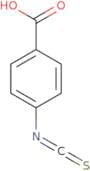
4-Isothiocyanatobenzoic acid, with the CAS number 2131-62-6, is an organic compound characterized by the presence of both a carboxylic acid and an isothiocyanate functional group. It features a benzene ring substituted at the para position with an isothiocyanate group (-N=C=S) and a carboxylic acid group (-COOH). This compound is typically a white to light yellow solid and is soluble in polar solvents such as water and alcohols, owing to the presence of the carboxylic acid group. It exhibits reactivity typical of isothiocyanates, including the ability to form thioureas and other derivatives through nucleophilic attack. 4-Isothiocyanatobenzoic acid is often used in chemical synthesis and as a reagent in various biochemical applications, particularly in the study of protein interactions and modifications. Additionally, it may have potential applications in medicinal chemistry due to its bioactive properties. Proper handling and storage are essential, as isothiocyanates can be irritants and may pose health risks.
Formula:C8H5NO2S
InChI:InChI=1S/C8H5NO2S/c10-8(11)6-1-3-7(4-2-6)9-5-12/h1-4H,(H,10,11)
InChI key:InChIKey=RBEFRYQKJYMLCC-UHFFFAOYSA-N
SMILES:C(O)(=O)C1=CC=C(N=C=S)C=C1
Synonyms:- 4-Icba
- 4-Isothiocyanatobenzoate
- 4-Isothiocyanatobenzoic acid
- Benzoic acid, 4-isothiocyanato-
- Benzoic acid, p-isothiocyanato-
- Nsc 52064
- p-Isothiocyanatobenzoic acid
- 4-Carboxyphenyl isothiocyanate
Sort by
Purity (%)
0
100
|
0
|
50
|
90
|
95
|
100
Found 4 products.
4-Carboxyphenyl isothiocyanate
CAS:Formula:C8H5NO2SPurity:97%Color and Shape:SolidMolecular weight:179.19584-Carboxyphenyl isothiocyanate
CAS:Formula:C8H5NO2SPurity:97.0%Color and Shape:SolidMolecular weight:179.194-Carboxyphenyl isothiocyanate
CAS:4-Carboxyphenyl isothiocyanate (4CPITC) is an antimicrobial agent that has been shown to inhibit the function of mitochondria by hyperpolarizing the mitochondrial membrane potential. It also inhibits cancer cell growth, which may be due to its effects on mitochondrial function. 4CPITC binds to mammalian cells and inhibits the production of reactive oxygen species and chloride ions. This inhibition has been shown to cause a decrease in hydrogen bond formation, which leads to a decrease in the rate of protein synthesis. 4CPITC has a chemical structure that includes ether linkages, which may contribute to its antimicrobial activity.Formula:C8H5NO2SPurity:Min. 95%Molecular weight:179.2 g/mol