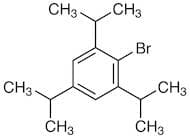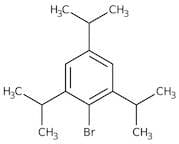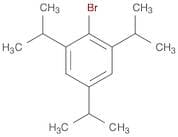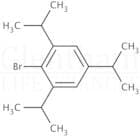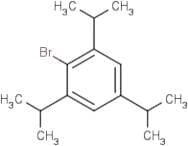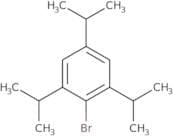
CAS 21524-34-5
:2-Bromo-1,3,5-triisopropylbenzene
Description:
2-Bromo-1,3,5-triisopropylbenzene is an organic compound characterized by its aromatic structure, featuring a bromine atom and three isopropyl groups attached to a benzene ring. The presence of the bromine substituent introduces a halogen, which can influence the compound's reactivity and physical properties, such as boiling and melting points. The isopropyl groups contribute to the steric bulk and hydrophobic character of the molecule, affecting its solubility in various solvents. Typically, compounds like this exhibit moderate to low solubility in water but are more soluble in organic solvents. The compound may be used in organic synthesis and as an intermediate in the production of other chemical substances. Its reactivity can be influenced by the bromine atom, which can undergo nucleophilic substitution reactions. Safety considerations should be taken into account when handling this compound, as brominated compounds can pose health risks. Overall, 2-Bromo-1,3,5-triisopropylbenzene is a notable compound in the field of organic chemistry due to its unique structural features and potential applications.
Formula:C15H23Br
InChI:InChI=1/C15H23Br/c1-9(2)12-7-13(10(3)4)15(16)14(8-12)11(5)6/h7-11H,1-6H3
SMILES:CC(C)c1cc(C(C)C)c(c(c1)C(C)C)Br
Synonyms:- 1-Bromo-2,4,6-triisopropylbenzene
- 2,4,6-Triisopropylbromobenzene
- 2-Bromo-1,3,5-Tri(Propan-2-Yl)Benzene
- 1,3,5-Triisopropyl-2-bromobenzene
- 1-Bromo-2,4,6-(triisopropyl)benzene
Sort by
Purity (%)
0
100
|
0
|
50
|
90
|
95
|
100
Found 7 products.
2-Bromo-1,3,5-triisopropylbenzene
CAS:Formula:C15H23BrPurity:>95.0%(GC)Color and Shape:Colorless to Light yellow clear liquidMolecular weight:283.252-Bromo-1,3,5-triisopropylbenzene, 96%
CAS:2-Bromo-1,3,5-triisopropylbenzene is used in Suzuki reaction. It is found to effect highly selective ring closures of homoallylic alcohols to substituted tetrahydrofurans. This Thermo Scientific Chemicals brand product was originally part of the Alfa Aesar product portfolio. Some documentation and lFormula:C15H23BrPurity:96%Color and Shape:Clear colorless to pale yellow, LiquidMolecular weight:283.252-Bromo-1,3,5-triisopropylbenzene
CAS:Formula:C15H23BrPurity:97%Color and Shape:LiquidMolecular weight:283.24712-Bromo-1,3,5-triisopropylbenzene
CAS:2-Bromo-1,3,5-triisopropylbenzene
Formula:C15H23BrPurity:97%Color and Shape: colourless liquidMolecular weight:283.25g/mol2-Bromo-1,3,5-triisopropylbenzene
CAS:Formula:C15H23BrPurity:97%Color and Shape:SolidMolecular weight:283.2532-Bromo-1,3,5-triisopropylbenzene
CAS:2-Bromo-1,3,5-triisopropylbenzene is an ethylene acetal that is prepared by the catalyzed reaction of aryl chlorides and anhydrous zinc bromide in the presence of triethylamine. The selectivities of this method are high because it can produce mainly a single isomer. The stereoselectivity is also high because the reaction proceeds with the formation of only one stereoisomer. The mechanism for this reaction involves a nucleophilic substitution of the halogenated aryl chloride with the trialkylborane, which generates two different products. This product has been used in the synthesis of biphenyls and nitro compounds.
Formula:C15H23BrPurity:Min. 95%Color and Shape:Colorless Clear LiquidMolecular weight:283.25 g/mol