CAS 21573-69-3
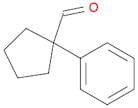
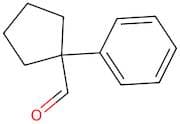
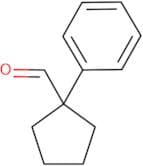
:1-phenylcyclopentanecarbaldehyde
Description:
1-Phenylcyclopentanecarbaldehyde, with the CAS number 21573-69-3, is an organic compound characterized by its aldehyde functional group attached to a cyclopentane ring that is further substituted with a phenyl group. This compound typically appears as a colorless to pale yellow liquid and has a distinctive aromatic odor due to the presence of the phenyl group. It is soluble in organic solvents such as ethanol and ether but has limited solubility in water. The compound is known for its potential applications in organic synthesis, particularly in the preparation of various pharmaceuticals and fine chemicals. Its reactivity is influenced by the aldehyde group, making it susceptible to nucleophilic addition reactions. Additionally, 1-phenylcyclopentanecarbaldehyde can undergo oxidation to form corresponding carboxylic acids or reduction to yield alcohols. Safety precautions should be taken when handling this compound, as with many aldehydes, due to potential irritant properties and the need for proper storage to prevent degradation.
Formula:C12H14O
InChI:InChI=1/C12H14O/c13-10-12(8-4-5-9-12)11-6-2-1-3-7-11/h1-3,6-7,10H,4-5,8-9H2
SMILES:c1ccc(cc1)C1(CCCC1)C=O
Synonyms:- Cyclopentanecarboxaldehyde, 1-Phenyl-
Sort by
Purity (%)
0
100
|
0
|
50
|
90
|
95
|
100
Found 4 products.
1-Phenylcyclopentanecarboxaldehyde
CAS:Formula:C12H14OPurity:97%Color and Shape:LiquidMolecular weight:174.23901-Phenylcyclopentanecarbaldehyde
CAS:1-PhenylcyclopentanecarbaldehydePurity:97%Molecular weight:174.24g/mol1-phenylcyclopentane-1-carbaldehyde
CAS:1-Phenylcyclopentane-1-carbaldehyde is an alkylating agent that reacts with nucleophiles to form a cyclic adduct. This reaction can be used for synthesizing epoxides, ketones, and aldehydes. It is also used in the synthesis of pharmaceuticals and other organic compounds. 1-Phenylcyclopentane-1-carbaldehyde is a diastereoisomeric reagent that can transform between different stereochemical configurations. The axial conformation is more stable than the tetrahedral configuration.Formula:C12H14OPurity:Min. 95%Molecular weight:174.24 g/mol