CAS 2167-51-3
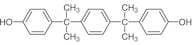
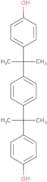
:Bisphenol P
- 1,4-Bis(1-(4-hydroxyphenyl)-1-methylethyl)benzene
- 1,4-Bis(4-hydroxycumyl)benzene
- 1,4-Bis(p-hydroxycumyl)benzene
- 1,4-Bis[2-(4-hydroxyphenyl)-2-propyl]benzene
- 1,4-Bis[α-methyl-α-(4-hydroxyphenyl)ethyl]benzene
- 4,4'-(Benzene-1,4-Diyldipropane-2,2-Diyl)Diphenol
- 4,4′-(p-Phenylenediisopropylidene)bisphenol
- 4,4′-(p-Phenylenediisopropylidene)diphenol
- 4,4′-[1,4-Phenylenebis(1-methylethylidene)]bis[phenol]
- B 1563
- Bisphenol P
- Phenol, 4,4′-(p-phenylenediisopropylidene)di-
- Phenol, 4,4′-[1,4-phenylenebis(1-methylethylidene)]bis-
- alpha,alpha-Bis(4-hydroxyphenyl)-1,4-diisopropylbenzene
- α,α′-Bis(4-hydroxyphenyl)-1,4-diisopropylbenzene
- See more synonyms
α,α'-Bis(4-hydroxyphenyl)-1,4-diisopropylbenzene
CAS:Formula:C24H26O2Purity:>98.0%(GC)Color and Shape:White to Almost white powder to crystalMolecular weight:346.47α,α'-BIS(4-HYDROXYPHENYL)-1,4-DIISOPROPYLBENZENE
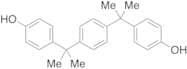
CAS:Formula:C24H26O2Purity:98%Color and Shape:SolidMolecular weight:346.46204,4’-(1,4-Phenylenediisopropylidene)Bisphenol
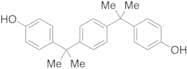
CAS:4,4’-(1,4-Phenylenediisopropylidene)BisphenolPurity:98%Molecular weight:346.46g/molBisphenol P 100 µg/mL in Methanol
CAS:Controlled ProductFormula:C24H26O2Color and Shape:Single SolutionMolecular weight:346.46Bisphenol P
CAS:Applications Bisphenol P is a derivative of Bisphenol A (B519495) which is a monomer used for policarbonate and epoxy resins.
References Krishnan, A.V., et al.: Endocrinology, 132, 2279 (1993); Steinmetz, R., et al.: Trends Endocrinol. Metab., 9, 124 (1998); Petersen, H., et al.: Eur. Food Res. Technol., 216, 355 (2003);Formula:C24H26O2Color and Shape:NeatMolecular weight:346.46Bisphenol P-13C4
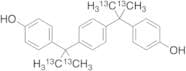
CAS:Applications Bisphenol P-13C4 is an isotope labelled analog of Bisphenol P. Bisphenol P is a derivative of Bisphenol A (B519495) which is a monomer used for policarbonate and epoxy resins.
References Krishnan, A.V., et al.: Endocrinology, 132, 2279 (1993); Steinmetz, R., et al.: Trends Endocrinol. Metab., 9, 124 (1998); Petersen, H., et al.: Eur. Food Res. Technol., 216, 355 (2003)Formula:C2013C4H26O2Color and Shape:NeatMolecular weight:350.43Bisphenol P-d16
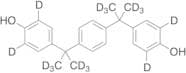
CAS:Controlled ProductApplications Bisphenol P-d16 is the isotope labelled analog of Bisphenol P. Bisphenol P is a derivative of Bisphenol A (B519495) which is a monomer used for policarbonate and epoxy resins.
Not a dangerous good if item is equal to or less than 1g/ml and there is less than 100g/ml in the package
References Krishnan, A.V., et al.: Endocrinology, 132, 2279 (1993); Steinmetz, R., et al.: Trends Endocrinol. Metab., 9, 124 (1998); Petersen, H., et al.: Eur. Food Res. Technol., 216, 355 (2003)Formula:C24H10D16O2Color and Shape:Off-WhiteMolecular weight:362.56α,α'-Bis(4-hydroxyphenyl)-1,4-diisopropylbenzene
CAS:4-Hydroxybenzoic acid (4HBA) is an organic compound that is used to manufacture polyester and polycarbonate plastics. This chemical has been found in the environment due to its use as a monomer in manufacturing. 4HBA has been shown to be toxic to human cells, causing oxidative stress and DNA damage. It can also cause autoimmune diseases by damaging gland cells. The presence of this chemical in wastewater can be reduced by installing a wastewater treatment system, which will remove 4HBA from the water supply before it is released into the environment.
Formula:C24H26O2Purity:Min. 95%Color and Shape:PowderMolecular weight:346.46 g/mol