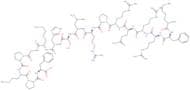
CAS 217082-57-0
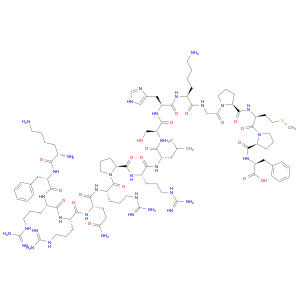
:L-Phenylalanine,L-lysyl-L-phenylalanyl-L-arginyl-L-arginyl-L-glutaminyl-L-arginyl-L-prolyl-L-arginyl-L-leucyl-L-seryl-L-histidyl-L-lysylglycyl-L-prolyl-L-methionyl-L-prolyl-
Description:
The substance you mentioned, with the name "L-Phenylalanine, L-lysyl-L-phenylalanyl-L-arginyl-L-arginyl-L-glutaminyl-L-arginyl-L-prolyl-L-arginyl-L-leucyl-L-seryl-L-histidyl-L-lysylglycyl-L-prolyl-L-methionyl-L-prolyl-" and CAS number 217082-57-0, is a complex peptide composed of multiple amino acids. This compound features a sequence that includes essential and non-essential amino acids, which are the building blocks of proteins. The presence of amino acids such as phenylalanine, lysine, arginine, glutamine, proline, leucine, serine, histidine, glycine, and methionine suggests that it may play a role in various biological functions, including protein synthesis and metabolic processes. Peptides like this can exhibit diverse properties, including solubility, stability, and biological activity, depending on their sequence and structure. Additionally, such compounds may have potential applications in pharmaceuticals, nutrition, and biochemistry, particularly in the study of protein interactions and functions. However, specific characteristics such as molecular weight, solubility, and biological activity would require further analysis and characterization.
Formula:C96H156N34O20S
Synonyms:- 16: PN: WO2006023893 SEQID: 3 claimedsequence
- 61-77-Apelin,prepro-
- 6: PN: WO2007072980 SEQID: 21 claimed protein
- Apelin-17
Sort by
Purity (%)
0
100
|
0
|
50
|
90
|
95
|
100
Found 6 products.
Apelin-17 (human, bovine, mouse, rat)
CAS:Apelin-17 is an endogenous ligand of the human orphan G protein-coupled receptor APJ, reported to act as a coreceptor of CD4 for human and simian immunodeficiency viruses. Apelin-17 and apelin-13 represent the predominant molecular forms of apelin present in the whole brain, hypothalamus, and plasma. Like apelin-13, apelin-17 exhibited a high activity on extracellular acidification rate and strongly inhibited forskolin-stimulated cAMP production in CHO cells expressing the human or the rat apelin receptor. The peptide might play a crucial role in the maintenance of body fluid homeostasis by counteracting AVP (arginine vasopressin) actions through inhibition of AVP neuron activity and AVP release.Formula:C96H156N34O20SPurity:> 98%Color and Shape:White PowderMolecular weight:2138.58Apelin-17(human, bovine)
CAS:Endogenous apelin receptor agonist. Potently inhibits forskolin-stimulated cAMP accumulation (pIC50 = 9.94).Formula:C96H156N34O20SPurity:98%Color and Shape:SolidMolecular weight:2138.56Apelin-17 trifluoroacetate - Bio-X ™
CAS:This product is part of our Bio-X ™ Range. These products are aimed at life science researchers who need high quality ready-to-use products for assay development, screening or other R&D work. With a solubility datasheet and convenient vials, all of our Bio-X ™ products are in stock across our global warehouses for rapid delivery and ease of use.Formula:C96H156N34O20S•C2HF3O2Purity:Min. 95%Color and Shape:PowderMolecular weight:2,252.57 g/mol(2S)-2-[[(2S)-1-[(2S)-2-[[(2S)-1-[2-[[(2S)-6-Amino-2-[[(2S)-2-[[(2S)-2-[[(2S)-2-[[(2S)-2-[[(2S)-1-[(2S)-2-[[(2S)-5-amino-2-[[(2S)-5- carbamimidamido-2-[[(2S)-5-carbamimidamido-2-[[(2S)-2-[[(2S)-2,6-diaminohexanoyl]amino]-3-phenylpropanoyl]amino]pentanoyl]
CAS:Custom research peptide; min purity 95%. For different specs please use the Peptide Quote ToolFormula:C96H156N34O20SMolecular weight:2,138.58 g/molApelin-17 trifluoroacetate
CAS:Apelin-17 trifluoroacetate is a reaction component, reagent and useful scaffold for the synthesis of complex compounds. It is a high quality, research chemical that is used in the synthesis of fine chemicals. Apelin-17 trifluoroacetate has versatile building block and can be used as a useful intermediate or as a speciality chemical. It also has high reactivity and is soluble in organic solvents.
Formula:C96H156N34O20S•C2HF3O2Purity:Min. 95%Color and Shape:PowderMolecular weight:2,252.57 g/mol