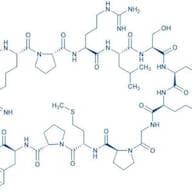
CAS 217082-60-5
:(Pyr1)-Apelin-13 (human, bovine)
Description:
(Pyr1)-Apelin-13 is a peptide that serves as a ligand for the apelin receptor, which is involved in various physiological processes, including cardiovascular regulation, fluid homeostasis, and energy metabolism. This substance is a modified form of the naturally occurring apelin-13 peptide, where the first proline residue is substituted with a pyrrolidine ring, enhancing its stability and bioactivity. The peptide is characterized by its relatively small size, consisting of 13 amino acids, and exhibits a high affinity for the apelin receptor, making it significant in research related to cardiovascular health and metabolic disorders. Its role in promoting vasodilation and influencing appetite regulation has garnered interest in therapeutic applications. Additionally, (Pyr1)-Apelin-13 is studied for its potential implications in conditions such as heart failure and obesity. The CAS number 217082-60-5 uniquely identifies this compound, facilitating its recognition in scientific literature and databases. Overall, (Pyr1)-Apelin-13 represents a valuable tool in biomedical research, particularly in understanding the apelin signaling pathway.
Formula:C69H108N22O16S
Synonyms:- (Pyr1)apelin-13
- (pGlu1)apelin-13
- Pyr-apelin-13
- L-Phenylalanine,5-oxo-L-prolyl-L-arginyl-L-prolyl-L-arginyl-L-leucyl-L-seryl-L-histidyl-L-lysylglycyl-L-prolyl-L-methionyl-L-prolyl-
- Pyr-Arg-Pro-Arg-Leu-Ser-His-Lys-Gly-Pro-Met-Pro-Phe-OH
Sort by
Purity (%)
0
100
|
0
|
50
|
90
|
95
|
100
Found 8 products.
PYR-ARG-PRO-ARG-LEU-SER-HIS-LYS-GLY-PRO-MET-PRO-PHE-OH
CAS:Formula:C69H108N22O16SPurity:97%Color and Shape:SolidMolecular weight:1533.7986[Pyr1]-Apelin-13
CAS:[Pyr1]-Apelin-13 ([pGlu1]-Apelin-13) is a potent and selective endogenous Apelin receptor (APJ) agonist.Formula:C69H108N22O16SPurity:99.71%Color and Shape:SolidMolecular weight:1533.8(Pyr 1)-Apelin-13
CAS:Endogenous ligand for apelin APJ receptor
Formula:C69H108N22O16SPurity:Min. 95%Color and Shape:White PowderMolecular weight:1,533.8 g/mol[Pyr]-Apelin-13
CAS:[Pyr1]-Apelin-13 acts as a ligand for the apelin receptor (APJ) G protein-coupled receptor and is a substrate for angiotensin-converting enzyme 2. Apelin is a member of the adipokine hormone family from adipose tissue. Adipokines are involved in processes such as vascular homeostasis and angiogenesis.Apelin and the apelin receptor are widely distributed throughout the body. Apelin is associated with cardiovascular diseases, obesity, diabetes and cancer. Apelin is expressed in the spinal cord and the human brain. Immunohistochemistry shows that apelin-17 is significantly expressed in the human heart, brain, lungs and endothelial cells. Studies show myocardial infarction apelin mRNA expression is greater during human heart failure than in healthy tissue. Apelin protects against heart failure due to the pyroglutamic form of apelin, [Pyr1]-Apelin-13, which decreases infarct size of myocardial infarctions. Furthermore, rats with hypertension have reduced levels of apelin and APJ. [Pyr1]-Apelin-13 exhibits higher APJ agonist potency than Apelin-13. We also have the alternative available.Formula:C69H108N22O16SColor and Shape:PowderMolecular weight:1,533.8 g/mol[Pyr1]-Apelin-13 (Human, Bovine)
CAS:Apelin-13 is a peptide that belongs to the class of activators. It has been shown to activate the ATP-sensitive potassium ion channels and inhibit the calcium ion channels in cells. Apelin-13 also binds to receptors on cells, which leads to activation of signaling pathways. The affinity for these receptors has been determined using an antibody. In addition, it has been shown that Apelin-13 interacts with other proteins and ligands in a variety of ways through protein interactions and receptor binding.Formula:C69H108N22O16SPurity:Min. 95%Molecular weight:1,533.8 g/mol(Pyr¹)-Apelin-13 (human, bovine, mouse, rat)
CAS:The pyroglutamyl form of apelin-13 exhibited a high activity with an EC₅₀ value of 0.30 nM. pERPRLSHKGPMPF is probably the final product of the post-translational modification of apelin and the biologically active endogenous ligand. (Pyr¹)-Apelin-13 has been identified as the predominant apelin isoform in the human heart. Pyr-Apelin-13 stimulates glucose utilization in normal and obese insulin-resistant mice. It could be required for the maintenance of insulin sensitivity.Formula:C69H108N22O16SPurity: 97.7%Color and Shape:White LyophilisateMolecular weight:1533.82(Pyr¹)-Apelin-13 (human, bovine, mouse, rat)
CAS:Bachem ID: 4104812.
Formula:C69H108N22O16SPurity:98.2301%Color and Shape:White PowderMolecular weight:1533.82

![[Pyr1]-Apelin-13](/_next/image/?url=https%3A%2Fstatic.cymitquimica.com%2Fproducts%2F54%2Fthumb%2FBUP01859.jpg&w=3840&q=75)

![[Pyr1]-Apelin-13](/_next/image/?url=https%3A%2Fstatic.cymitquimica.com%2Fproducts%2FTM%2Fthumb%2FTP1260.jpg&w=3840&q=75)


![[Pyr]-Apelin-13](/_next/image/?url=https%3A%2Fstatic.cymitquimica.com%2Fproducts%2F3D%2Fthumb%2FCRB1000443.jpg&w=3840&q=75)
![[Pyr1]-Apelin-13 (Human, Bovine)](/_next/image/?url=https%3A%2Fstatic.cymitquimica.com%2Fproducts%2F3D%2Fthumb%2FPAP-4361-V.jpg&w=3840&q=75)