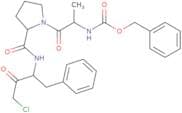
CAS 217658-18-9
:Z-ALA-PRO-PHE-CHLOROMETHYLKETONE
Description:
Z-ALA-PRO-PHE-CHLOROMETHYLKETONE, also known as Z-APF-CHMK, is a synthetic peptide derivative characterized by its unique structure, which includes a Z (benzyloxycarbonyl) protecting group on the amino terminus, and a chloromethyl ketone functional group. This compound is primarily used in biochemical research, particularly in the study of proteases and enzyme inhibition, due to its ability to irreversibly modify active site residues. The presence of the chloromethyl ketone moiety allows for covalent bonding with nucleophilic amino acids, such as serine or cysteine, making it a valuable tool in the development of enzyme inhibitors. Its molecular structure contributes to its specificity and reactivity, which are critical for its applications in drug discovery and protein engineering. Additionally, Z-ALA-PRO-PHE-CHLOROMETHYLKETONE is typically handled with care in laboratory settings, as it may pose hazards associated with reactive chemical groups. Proper safety protocols should be followed when working with this compound.
Formula:C26H30ClN3O5
Synonyms:- L-Prolinamide, N-[(phenylmethoxy)carbonyl]-L-alanyl-N-[(1S)-3-chloro-2-oxo-1-(phenylmethyl)propyl]- (9CI)
- Z-ALA-PRO-PHE-CMK
- Z-ALA-PRO-PHE-CHLOROMETHYLKETONE
Sort by
Purity (%)
0
100
|
0
|
50
|
90
|
95
|
100
Found 2 products.
Z-Ala-Pro-Phe-chloromethylketone
CAS:Z-APF-CMK, inhibitor of the Ca²⁺-regulated nuclear scaffold proteinase (CRNSP), blocks the degradation of lamin B₁.Formula:C26H30ClN3O5Purity:> 98%Color and Shape:White PowderMolecular weight:499.99Z-Ala-Pro-Phe-chloromethylketone
CAS:Z-Ala-Pro-Phe-chloromethylketone is a cytosolic protein that performs its function by denaturing proteins and is localized in the cytosol. It has been shown to be active against a number of bacteria, including Bacillus licheniformis and Listeria monocytogenes, as well as some fungi. Z-Ala-Pro-Phe-chloromethylketone targets the membrane potential in mitochondria and chloromethyl ketone is a strategy for inhibiting membrane potential in mitochondria. The x-ray diffraction data show that this protein forms a molecule with an alpha helix structure. It binds to the mitochondrial inner membrane by ligation and inhibits mitochondrial membrane potential.Formula:C26H30ClN3O5Purity:Min. 95%Molecular weight:499.99 g/mol