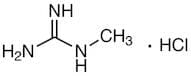
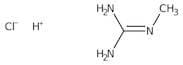
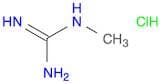
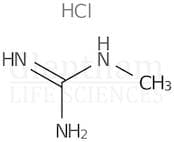
CAS 21770-81-0
:1-Methylguanidine hydrochloride
Description:
1-Methylguanidine hydrochloride is a chemical compound characterized by its guanidine structure, where a methyl group is attached to the nitrogen atom. It appears as a white to off-white crystalline powder and is soluble in water, making it suitable for various applications in biochemical and pharmaceutical research. The compound is known for its role as a reagent in organic synthesis and as a potential intermediate in the production of pharmaceuticals. It exhibits basic properties due to the presence of guanidine, which can participate in protonation and deprotonation reactions. Additionally, 1-methylguanidine hydrochloride has been studied for its potential biological activities, including its effects on nitric oxide synthesis and its role in cellular signaling pathways. Safety considerations should be taken into account when handling this compound, as it may pose health risks if ingested or inhaled. Proper laboratory practices and personal protective equipment are recommended to mitigate exposure.
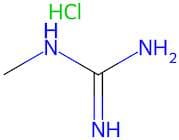
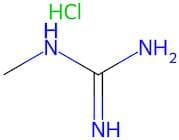
Formula:C2H7N3·ClH
InChI:InChI=1S/C2H7N3.ClH/c1-5-2(3)4;/h1H3,(H4,3,4,5);1H
InChI key:InChIKey=VJQCNCOGZPSOQZ-UHFFFAOYSA-N
SMILES:C(NC)(=N)N.Cl
Synonyms:- (E)-amino(imino)-N-methylmethanaminium chloride
- Guanidine, N-methyl-, hydrochloride (1:1)
- Guanidine, methyl-, monohydrochloride
- Methylguanidine Hydrochloride
- Methylguanidinium chloride
- N-Methylguanidine hydrochloride
- N-Methylguanidine monohydrochloride
- 1-methylguanidine hydrochloride
- 1-Methylguanidine hydrochloride
Sort by
Purity (%)
0
100
|
0
|
50
|
90
|
95
|
100
Found 11 products.
1-Methylguanidine Hydrochloride
CAS:Formula:C2H7N3·HClPurity:>98.0%(T)(N)Color and Shape:White to Almost white powder to crystalMolecular weight:109.56Methylguanidine hydrochloride, 98%
CAS:Methylguanidine hydrochloride can be used in the synthesis of biaryl derivatives which were evaluated as BACE1 inhibitors. This Thermo Scientific Chemicals brand product was originally part of the Alfa Aesar product portfolio. Some documentation and label information may refer to the legacy brand. TFormula:C2H7N3•HClPurity:98%Molecular weight:109.561-Methylguanidine hydrochloride
CAS:Formula:C2H8ClN3Purity:98%Color and Shape:SolidMolecular weight:109.55801-Methylguanidine hydrochloride
CAS:Formula:C2H7N3·HClPurity:(Titration) ≥ 98.0%Color and Shape:White to off-white powder or crystalsMolecular weight:109.561-Methylguanidine Hydrochloride
CAS:1-Methylguanidine HydrochloridePurity:98%Molecular weight:109.56g/mol1-Methylguanidine hydrochloride
CAS:1-Methylguanidine hydrochloridePurity:≥98%Molecular weight:109.56g/molMethylguanidine HCl
CAS:Formula:C2H7N3·HClColor and Shape:White To Off-White SolidMolecular weight:73.10 36.461-Methylguanidine hydrochloride
CAS:MG derived from protein breakdown, may be toxic in renal failure but has anti-inflammatory properties, inhibiting iNOS and TNF- release.Formula:C2H8ClN3Purity:98% - 99.02%Color and Shape:CrystallineMolecular weight:109.56N-Methylguanidine Hydrochloride
CAS:Controlled ProductStability Hygroscopic
Applications N-Methylguanidine is an alkylated guanidine which shows inhibitory action against trypsin catalysis. N-Methylguanidine inhibited metabolism of certain hepatic drugs that was mediated by cytochrome P 450 protein in human liver microsome and hepatocyte.
References Inagami, T. et al.: Biochemistry, 7, 4045 (1968); Hanada, K. et al.: Nephron, 103, 179 (2006);Formula:C2H8ClN3Color and Shape:NeatMolecular weight:109.561-Methylguanidine hydrochloride
CAS:Formula:C2H8ClN3Purity:95%Color and Shape:Chunks,Crystalline Powder,PowderMolecular weight:109.56Methylguanidine HCl
CAS:Methylguanidine HCl is a denaturing agent that can be used in the analysis of organic substances. It is used to study the biological properties of nitrogen-containing molecules, such as peroneal nerve. Methylguanidine HCl has been shown to have anti-inflammatory activity and can be used as an analgesic. Methylguanidine HCl binds to the ionotropic glutamate receptors, which are chloride channels, and this binding leads to an increase in intracellular chloride concentrations. This effect on chloride ions may be responsible for its ability to reduce pain sensation. Methylguanidine HCl also has a modulating effect on the synthesis of creatine and nitric oxide in serum levels.Formula:C2H8ClN3Purity:Min. 95%Molecular weight:109.56 g/mol