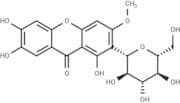
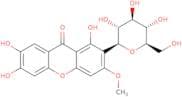
CAS 21794-66-1
:Homomangiferin
Description:
Homomangiferin is a naturally occurring flavonoid glycoside, primarily derived from the mango tree (Mangifera indica) and other plants. It is characterized by its chemical structure, which includes a flavonoid backbone with sugar moieties attached, contributing to its solubility and biological activity. This compound is known for its potential antioxidant, anti-inflammatory, and antimicrobial properties, making it of interest in both pharmacological and nutraceutical research. Homomangiferin has been studied for its effects on various biological pathways, including its role in modulating oxidative stress and inflammation. Additionally, it may exhibit protective effects against certain diseases, although further research is needed to fully elucidate its mechanisms of action and therapeutic potential. Its CAS number, 21794-66-1, is a unique identifier that facilitates the cataloging and study of this compound in scientific literature and databases. Overall, homomangiferin represents a promising area of study within the field of natural products and their applications in health and medicine.
Formula:C20H20O11
InChI:InChI=1S/C20H20O11/c1-29-10-4-11-13(15(24)6-2-7(22)8(23)3-9(6)30-11)17(26)14(10)20-19(28)18(27)16(25)12(5-21)31-20/h2-4,12,16,18-23,25-28H,5H2,1H3/t12-,16-,18+,19-,20+/m1/s1
InChI key:InChIKey=HDPSXKXQSOVYLL-PQSJUMPYSA-N
SMILES:O(C)C1=C(C(O)=C2C(=C1)OC=3C(C2=O)=CC(O)=C(O)C3)[C@@H]4O[C@H](CO)[C@@H](O)[C@H](O)[C@H]4O
Synonyms:- Mangiferin methyl ether
- 9H-Xanthen-9-one, 2-β-D-glucopyranosyl-1,6,7-trihydroxy-3-methoxy-
- Homomangiferin
- 2-β-D-Glucopyranosyl-1,6,7-trihydroxy-3-methoxy-9H-xanthen-9-one
- Mangiferin, 3-O-methyl-
Sort by
Purity (%)
0
100
|
0
|
50
|
90
|
95
|
100
Found 2 products.
Homomangiferin
CAS:Homomangiferin eases coughs, asthma, and has anti-tumor effects on MDA-MB-231 cells.Formula:C20H20O11Purity:98%Color and Shape:SolidMolecular weight:436.37Homomangiferin
CAS:Homomangiferin is a xanthone derivative, which is extracted primarily from the leaves of the mango tree, Mangifera indica. This natural compound belongs to a class of polyphenolic compounds known for their potential health benefits and is most notably sourced from various parts of the mango plant, including its leaves and bark.
Formula:C20H20O11Purity:Min. 95%Color and Shape:PowderMolecular weight:436.37 g/mol