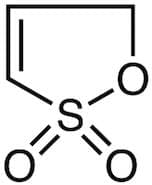
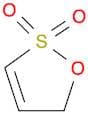
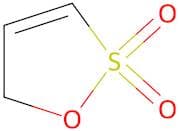
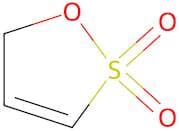
CAS 21806-61-1
:5H-1,2-Oxathiole, 2,2-dioxide
Description:
5H-1,2-Oxathiole, 2,2-dioxide, with the CAS number 21806-61-1, is a heterocyclic compound characterized by a five-membered ring containing sulfur and oxygen atoms. This compound features a unique oxathiole structure, where the sulfur atom is bonded to two oxygen atoms, resulting in a dioxo functional group. It is typically a colorless to pale yellow solid or liquid, depending on its purity and specific form. The presence of the oxathiole ring contributes to its potential reactivity, particularly in nucleophilic substitution reactions. This compound may exhibit interesting biological activities, making it of interest in medicinal chemistry and agricultural applications. Its stability and solubility can vary based on the solvent and environmental conditions. As with many sulfur-containing compounds, it may have distinctive odors and can participate in various chemical reactions, including oxidation and reduction processes. Safety data should be consulted for handling and storage, as with any chemical substance.
Formula:C3H4O3S
InChI:InChI=1S/C3H4O3S/c4-7(5)3-1-2-6-7/h1,3H,2H2
InChI key:InChIKey=KLLQVNFCMHPYGL-UHFFFAOYSA-N
SMILES:O=S1(=O)C=CCO1
Synonyms:- 1,3-Propene Sultone
- 1-Propene-1,3-Sultone
- 1-Propene-1-sulfonic acid, 3-hydroxy-, γ-sultone
- 5H-1,2-Oxathiole 2,2-dioxide
Sort by
Purity (%)
0
100
|
0
|
50
|
90
|
95
|
100
Found 6 products.
1-Propene 1,3-Sultone
CAS:Formula:C3H4O3SPurity:>99.0%(GC)Color and Shape:White to Almost white powder to crystalMolecular weight:120.12Prop-1-ene-1,3-sultone
CAS:Prop-1-ene-1,3-sultone is a chiral compound that can be used as a photoelectron sensitizer. The anion radical created by protonation or deprotonation of the ionized form of prop-1-ene-1,3-sultone can be used to generate singlet oxygen and hydrogen peroxide, which are able to oxidize organic compounds. This compound is also useful in asymmetric synthesis due to its ability to act as a ligand for transition metal ions, such as Fe2+. Prop-1-ene-1,3-sultone has also been shown to have antioxidant properties and is soluble in both organic solvents and deionized water.
Formula:C3H4O3SPurity:Min. 95%Molecular weight:120.13 g/mol