CAS 21943-50-0
:2-bromocyclopentanone
Description:
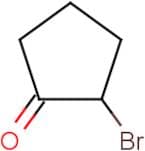
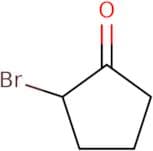
2-Bromocyclopentanone is a cyclic ketone characterized by the presence of a bromine atom attached to the second carbon of the cyclopentanone ring. Its molecular formula is C5H7BrO, indicating it contains five carbon atoms, seven hydrogen atoms, one bromine atom, and one oxygen atom. This compound typically appears as a colorless to pale yellow liquid with a distinctive odor. It is soluble in organic solvents such as ethanol and ether but has limited solubility in water due to its hydrophobic cyclopentane structure. The presence of the bromine atom introduces reactivity, making it a useful intermediate in organic synthesis, particularly in the formation of various derivatives through nucleophilic substitution reactions. Additionally, 2-bromocyclopentanone can undergo various chemical transformations, including reduction and oxidation, which can be exploited in synthetic organic chemistry. Safety precautions should be taken when handling this compound, as it may pose health risks if inhaled or ingested, and proper storage conditions should be maintained to ensure stability.
Formula:C5H7BrO
InChI:InChI=1/C5H7BrO/c6-4-2-1-3-5(4)7/h4H,1-3H2
SMILES:C1CC(C(=O)C1)Br
Synonyms:- Cyclopentanone, 2-Bromo-
- 2-BROMOCYCLOPENTANONE
Sort by
Purity (%)
0
100
|
0
|
50
|
90
|
95
|
100
Found 2 products.
2-Bromocyclopentanone
CAS:2-BromocyclopentanonePurity:95% (stabilized with HQ+CaCO3)Molecular weight:163.01g/mol2-Bromocyclopentanone
CAS:2-Bromocyclopentanone is an organic molecule that is used in the synthesis of epoxides. It is also a potential precursor for the synthesis of polymers, dyes, and pharmaceuticals. 2-Bromocyclopentanone has been shown to undergo photolysis when irradiated with ultraviolet light or through chemical reaction with acetonitrile. This product has two conformers with different rotational barriers and corresponding spectral properties. The two conformers can be distinguished by their ultraviolet spectra. The synthetic methods for 2-bromocyclopentanone involve halogenation followed by hydrolysis to yield bromoacetic acid, which is then converted to the desired product by acylation or alkylation.
Formula:C5H7BrOPurity:Min. 95%Molecular weight:163.01 g/mol