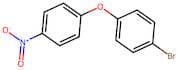
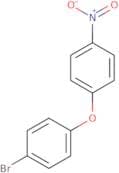
CAS 21969-04-0
:1-bromo-4-(4-nitrophenoxy)benzene
Description:
1-Bromo-4-(4-nitrophenoxy)benzene is an organic compound characterized by its aromatic structure, which includes a bromine atom and a nitrophenoxy group attached to a benzene ring. This compound features a bromine substituent at the para position relative to the nitrophenoxy group, which is itself a phenyl ether containing a nitro group. The presence of the nitro group imparts significant electron-withdrawing properties, influencing the compound's reactivity and polarity. Typically, such compounds exhibit moderate solubility in organic solvents and limited solubility in water due to their hydrophobic aromatic nature. They may participate in electrophilic aromatic substitution reactions, and their bromine atom can serve as a leaving group in nucleophilic substitution reactions. Additionally, 1-bromo-4-(4-nitrophenoxy)benzene may have applications in organic synthesis, particularly in the development of pharmaceuticals or agrochemicals, owing to its functional groups that can be further modified. Safety precautions should be observed when handling this compound, as it may pose health risks due to the presence of the bromine and nitro groups.
Formula:C12H8BrNO3
InChI:InChI=1/C12H8BrNO3/c13-9-1-5-11(6-2-9)17-12-7-3-10(4-8-12)14(15)16/h1-8H
SMILES:c1cc(ccc1Br)Oc1ccc(cc1)N(=O)=O
Synonyms:- 4-Bromophenyl 4-nitrophenyl ether
- Benzene, 1-Bromo-4-(4-Nitrophenoxy)-
Sort by
Purity (%)
0
100
|
0
|
50
|
90
|
95
|
100
Found 4 products.
1-Bromo-4-(4-nitrophenoxy)benzene
CAS:Formula:C12H8BrNO3Purity:95%Color and Shape:SolidMolecular weight:294.10081-Bromo-4-(4-nitrophenoxy)benzene
CAS:1-Bromo-4-(4-nitrophenoxy)benzenePurity:95%Molecular weight:294.10g/mol1-Bromo-4-(4-nitrophenoxy)benzene
CAS:1-Bromo-4-(4-nitrophenoxy)benzene is a copper-catalyzed coupling reaction that produces 1,2,3-triazoles. The reaction involves the coupling of an aryl halide with a triarylphosphine oxide to produce an aryl ether. The catalyst used in this reaction is copper oxide, which is produced by reacting copper with hydrochloric acid and then air. This technique is efficient and can be used to make nanoparticles.
Formula:C12H8BrNO3Purity:Min. 95%Molecular weight:294.1 g/mol