CAS 219821-37-1
:Sort by
Purity (%)
0
100
|
0
|
50
|
90
|
95
|
100
Found 5 products.
Aprepitant Impurity 9
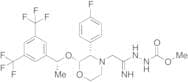
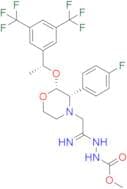
CAS:Formula:C24H25F7N4O4Color and Shape:Pale Yellow SolidMolecular weight:566.482-(R)-[1-(R)-(3,5-Bis(trifluoromethyl)phenyl)ethoxy]-3-(S)-fluorophenyl-4-[(2-N-methoxycarbonyl)acetamidrazono]morpholine-13C2,d2
CAS:Controlled ProductApplications Labelled Aprepitant derivative.
References Ballard, T., et al.: Eur. J. Pharmacol., 412, 255 (2001), Campos, D., et al.: J. Clin. Oncol., 19, 1759 (2001), Severini, C., et al.: Pharmacol. Rev., 54, 285 (2002)Formula:C22C2H23D2F7N4O4Color and Shape:NeatMolecular weight:570.47N-(Destriazolonomethyl) N-(Methylcarboxyacetamidohydrazono) Aprepitant
CAS:Controlled ProductFormula:C24H25F7N4O4Color and Shape:NeatMolecular weight:566.468N-(Destriazolonomethyl) N-(methylcarboxyacetamidohydrazono) aprepitant
CAS:Aprepitant is a peptide that is an inhibitor of the neurokinin 1 (NK1) receptor. It has been shown to bind to both the free and bound forms of this receptor, inhibiting its activity. Aprepitant is a potent activator of the NK2 receptor, which may be why it also produces strong antiemetic effects. The compound has high purity, with no detectable impurities or aggregates. Aprepitant is used as a research tool in cell biology and pharmacology studies, as well as for the treatment of nausea and vomiting caused by cancer chemotherapy. It binds to the NK1 receptor in the central nervous system, blocking substance P from binding to its receptors on neurons. This prevents substance P from stimulating nerve cells and producing nausea and vomiting.Formula:C24H25F7N4O4Purity:Min. 95%Molecular weight:566.50 g/mol

![2-(R)-[1-(R)-(3,5-Bis(trifluoromethyl)phenyl)ethoxy]-3-(S)-fluorophenyl-4-[(2-N-methoxycarbonyl)ac…](/_next/image/?url=https%3A%2Fstatic.cymitquimica.com%2Fproducts%2FTR%2Fthumb%2FB657147.jpg&w=3840&q=75)