CAS 2199-49-7
:Ethyl 4-methylpyrrole-3-carboxylate
Description:
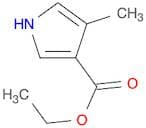
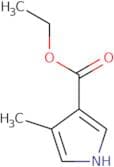
Ethyl 4-methylpyrrole-3-carboxylate is an organic compound characterized by its pyrrole ring structure, which is a five-membered aromatic heterocycle containing nitrogen. This compound features an ethyl ester functional group, contributing to its reactivity and solubility properties. The presence of the methyl group at the 4-position of the pyrrole ring influences its electronic properties and steric hindrance, which can affect its reactivity in various chemical reactions. Ethyl 4-methylpyrrole-3-carboxylate is typically a colorless to pale yellow liquid or solid, depending on its purity and form. It is soluble in organic solvents, making it useful in organic synthesis and as an intermediate in the production of pharmaceuticals and agrochemicals. The compound may exhibit biological activity, which is of interest in medicinal chemistry. Safety data should be consulted for handling, as with any chemical substance, to ensure proper precautions are taken during use.
Formula:C8H11NO2
InChI:InChI=1/C8H11NO2/c1-3-11-8(10)7-5-9-4-6(7)2/h4-5,9H,3H2,1-2H3
SMILES:CCOC(=O)c1c[nH]cc1C
Synonyms:- ethyl 4-methyl-1H-pyrrole-3-carboxylate
Sort by
Purity (%)
0
100
|
0
|
50
|
90
|
95
|
100
Found 5 products.
Ethyl 4-methyl-1H-pyrrole-3-carboxylate
CAS:Formula:C8H11NO2Purity:97%Color and Shape:SolidMolecular weight:153.1784Ethyl 4-methyl-1H-pyrrole-3-carboxylate
CAS:Ethyl 4-methyl-1H-pyrrole-3-carboxylatePurity:95%Molecular weight:153.181g/molEthyl 4-methyl-1H-pyrrole-3-carboxylate
CAS:Formula:C8H11NO2Purity:95%Color and Shape:SolidMolecular weight:153.181Ethyl 4-methylpyrrole 3-carboxylate
CAS:Ethyl 4-methylpyrrole 3-carboxylate is a monomer that belongs to the group of functional groups. It is used in the polymerization process and has been shown to be able to imprint or introduce other functional groups into polymers. The following are some of its properties: it can be used as an operational group, it has chemical interactions with other functional groups, and it can be used for selectivity techniques. It also has isomeric properties, which depend on the type of functional group attached. Some examples of these properties are electrochemical polymerization and electropolymerization. The molecule also interacts with different polarities depending on the type of functional group attached.Formula:C8H11NO2Purity:Min. 95%Color and Shape:Yellow PowderMolecular weight:153.18 g/mol