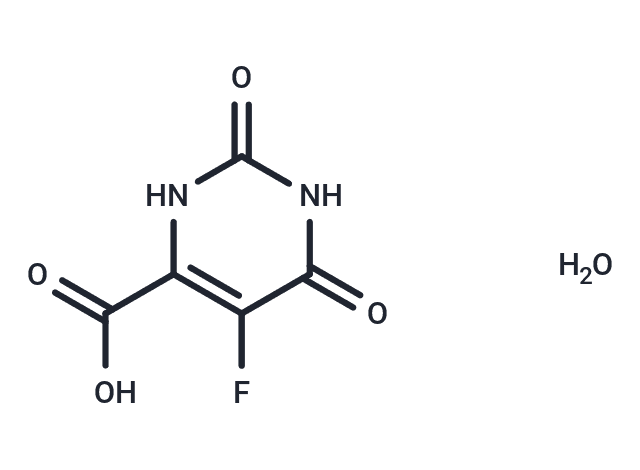
CAS 220141-70-8
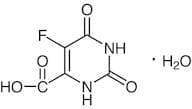
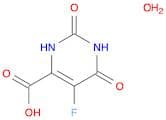
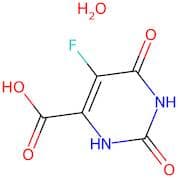
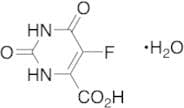
:5-Fluoroorotic acid monohydrate
5-Fluoroorotic Acid Monohydrate
CAS:Formula:C5H3FN2O4·H2OPurity:>95.0%(T)(HPLC)Color and Shape:White to Light yellow to Light orange powder to crystalMolecular weight:192.115-FLUOROOROTIC ACID HYDRATE 98
CAS:Formula:C5H5FN2O5Purity:98%Color and Shape:SolidMolecular weight:192.10205-Fluoroorotic acid monohydrate
CAS:5-Fluoroorotic acid monohydrateFormula:C5H3FN2O4·H2OPurity:97%Color and Shape: faint yellow crystalline powderMolecular weight:192.10g/mol5-Fluoroorotic Acid Monohydrate
CAS:Applications 5-FOA has become a valuable tool for research in the field of molecular genetics. It has been employed in the selection of resistant strains of Saccharomyces cerevisiae that possess a mutant URA3 gene which renders them orotidine-5'-phosphate decarboxylase deficient. 5-FOA is coverted to 5-fluorouridine monophosphate (5-FUMP) in yeast cells, which can become incorporated into RNA or metabolized to the highly toxic 5-fluoro-2’-deoxyuridine monophosphate (5-FdUMP). 5-FdUMP is a potent inhibitor of thymidylate synthase (TS), causing the cessation of DNA synthesis. More recently, 5-FOA has been shown to possess potent antimalarial activity against both chloroquine-susceptible and chloroquine-resistant clones of Plasmodium falciparum. Studies indicate that TS is the primary target of 5-FOA in m
References Winston, F., et al.: Genetics, 107, 179 (1984); Boeke, J.D., et al.: Methods Enzymol., 154, 164 (1987); Rathod, P.K., et al.: Antimicrob. Agents Chemother., 33, 1090 (1989); Rathod, P.K., et al.: Antimicrob. Agents Chemother., 36, 704 (1992); Gomez, Z.M . and Rathod, P.K.: Antimicrob. Agents Chemother., 34, 1371 (1990); Gassis, S. and Rathod, P.K.: Antimicrob. Agents Chemother., 40, 914 (1996)Formula:C5H5FN2O5Color and Shape:White SolidMolecular weight:192.15-Fluoroorotic Acid Monohydrate (5-FOA Monohydrate) for molecular biology, 98%
CAS:Formula:C5H3FN2O4·H2OPurity:min. 98%Color and Shape:Off white to pale yellow, PowderMolecular weight:192.105-Fluoroorotic acid, monohydrate
CAS:Formula:C5H5FN2O5Purity:97%Color and Shape:Solid, Crystalline Powder or PowderMolecular weight:192.1025-Fluoroorotic acid monohydrate
CAS:5-Fluoroorotic acid (monohydrate) (5-Fluorouracil-6-carboxylic acid Mono(hydrate); 5-FOA) is employed to detect the expression of the URA3 gene in yeast molecular genetic constructs. Yeast possessing an active URA3 gene (which encodes orotidine-5'-monophosphate decarboxylase) convert 5-FOA into 5-fluorodeoxyuridine, a substance toxic to cells. Yeast strains with mutations in the URA3 gene that confer resistance can grow in the presence of 5-FOA if uracil is added to the medium.Formula:C5H5FN2O5Color and Shape:SolidMolecular weight:192.10