CAS 220620-09-7
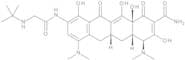
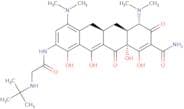
:Tigecycline
Description:
Tigecycline is a broad-spectrum glycylcycline antibiotic, structurally related to tetracyclines, and is primarily used to treat various bacterial infections, particularly those caused by multidrug-resistant organisms. It exhibits a unique mechanism of action by inhibiting bacterial protein synthesis through binding to the 30S ribosomal subunit, thereby preventing the incorporation of amino acids into peptides. Tigecycline is effective against a wide range of Gram-positive and Gram-negative bacteria, including some strains of methicillin-resistant Staphylococcus aureus (MRSA) and vancomycin-resistant Enterococcus (VRE). It is typically administered intravenously and is indicated for complicated skin and skin structure infections, complicated intra-abdominal infections, and community-acquired pneumonia. Tigecycline has a relatively low oral bioavailability, which is why parenteral administration is preferred. Its side effects may include nausea, vomiting, and potential liver enzyme elevation. Due to its broad activity and effectiveness against resistant strains, tigecycline plays a crucial role in the treatment of serious infections, although its use is often reserved for specific cases to mitigate the risk of resistance development.
Formula:C29H39N5O8
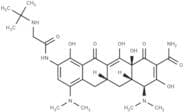
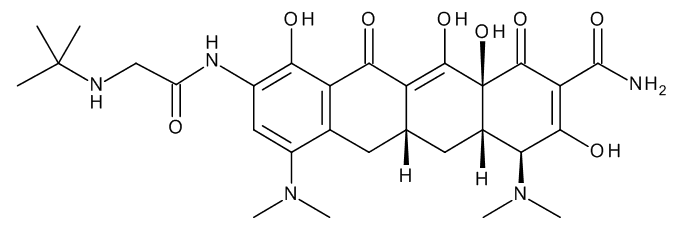
InChI:InChI=1S/C29H39N5O8/c1-28(2,3)31-11-17(35)32-15-10-16(33(4)5)13-8-12-9-14-21(34(6)7)24(38)20(27(30)41)26(40)29(14,42)25(39)18(12)23(37)19(13)22(15)36/h10,12,14,21,31,36,38-39,42H,8-9,11H2,1-7H3,(H2,30,41)(H,32,35)/t12-,14-,21-,29-/m0/s1
InChI key:InChIKey=FPZLLRFZJZRHSY-HJYUBDRYSA-N
SMILES:O[C@]12[C@]([C@H](N(C)C)C(O)=C(C(N)=O)C1=O)(C[C@]3(C(=C2O)C(=O)C=4C(C3)=C(N(C)C)C=C(NC(CNC(C)(C)C)=O)C4O)[H])[H]
Synonyms:- 2-Naphthacenecarboxamide, 4,7-bis(dimethylamino)-9-[[[(1,1-dimethylethyl)amino]acetyl]amino]-1,4,4a,5,5a,6,11,12a-octahydro-3,10,12,12a-tetrahydroxy-1,11-dioxo-, (4S,4aS,5aR,12aS)-
- GAR 936
- 2-Naphthacenecarboxamide, 4,7-bis(dimethylamino)-9-[[2-[(1,1-dimethylethyl)amino]acetyl]amino]-1,4,4a,5,5a,6,11,12a-octahydro-3,10,12,12a-tetrahydroxy-1,11-dioxo-, (4S,4aS,5aR,12aS)-
- WAY-GAR 936
- (4S,4aS,5aR,12aS)-4,7-Bis(dimethylamino)-9-[[2-[(1,1-dimethylethyl)amino]acetyl]amino]-1,4,4a,5,5a,6,11,12a-octahydro-3,10,12,12a-tetrahydroxy-1,11-dioxo-2-naphthacenecarboxamide
Sort by
Purity (%)
0
100
|
0
|
50
|
90
|
95
|
100
Found 14 products.
Tigecycline
CAS:Formula:C29H39N5O8Purity:>98.0%(HPLC)Color and Shape:Light yellow to Brown powder to crystalMolecular weight:585.66Tigecycline
CAS:Tetracyclines and their derivatives; salts thereofFormula:C29H39N5O8Color and Shape:Orange PowderMolecular weight:585.27986(4S,4aS,5aR,12aS)-4,7-Bis(dimethylamino)-9-[[2-[(1,1-dimethylethyl)amino]acetyl]amino]-1,4,4a,5,5a,6,11,12a-octahydro-3,10,12,12a-tetrahydroxy-1,11-dioxo-2-naphthacenecarboxamide
CAS:Formula:C29H39N5O8Purity:96%Color and Shape:SolidMolecular weight:585.6487Tigecycline
CAS:Tigecycline (GAR-936), a broad-spectrum glycylcycline, disrupts protein synthesis by binding the 30S ribosomal subunit.Formula:C29H39N5O8Purity:98.81% - >99.99%Color and Shape:PowderMolecular weight:585.65Ref: TM-T1569
5mg35.00€10mg54.00€1mL*10mM (DMSO)56.00€25mg74.00€50mg100.00€100mg159.00€200mg235.00€500mg395.00€Tigecycline
CAS:Stability Light Sensitive
Applications A glycylcycline antibiotic, used to treat infection by drug resistant bacteria such as Staphylococcus aureus (Staph aureus) and Acinetobacter baumannii.
References Lim, T., et al.: J. Antibiotics, 62, 675 (2009), Presterl, E., et al.: Antimicrob. Agents Chemother., 53, 3205 (2009), Varma, M., et al.: J. Med. Chem., 52, 4844 (2009),Formula:C29H39N5O8Color and Shape:NeatMolecular weight:585.65Tigecycline
CAS:Inhibitor of protein synthesis; glycylcycline class
Formula:C29H39N5O8Purity:Min. 98 Area-%Color and Shape:Orange PowderMolecular weight:585.65 g/molTigecycline, Antibiotic for Culture Media Use Only
CAS:Tigecycline is an antibiotic specifically tailored for use in culture media, which is derived from glycylcycline, a structural analogue of minocycline. Its mode of action involves binding to the 30S ribosomal subunit, thereby inhibiting protein synthesis in a broad spectrum of Gram-positive and Gram-negative bacteria. This action is distinct and not easily circumvented by common resistance mechanisms, such as efflux or ribosomal protection proteins, making tigecycline an effective agent in controlling bacterial contamination during microbiological studies.Formula:C29H39N5O8Purity:Min. 95 Area-%Molecular weight:585.65 g/mol


![(4S,4aS,5aR,12aS)-4,7-Bis(dimethylamino)-9-[[2-[(1,1-dimethylethyl)amino]acetyl]amino]-1,4,4a,5,5a…](/_next/image/?url=https%3A%2Fstatic.cymitquimica.com%2Fproducts%2FIN%2Fthumb%2FDA003UT8.jpg&w=3840&q=75)