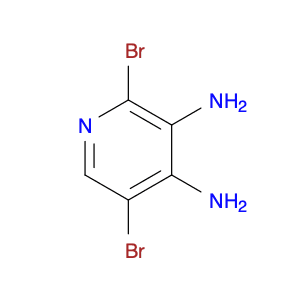
CAS 221241-11-8
:3,4-Pyridinediamine, 2,5-dibromo-
Description:
3,4-Pyridinediamine, 2,5-dibromo- is an organic compound characterized by its pyridine ring structure, which is a six-membered aromatic ring containing one nitrogen atom. This compound features two amino groups (-NH2) at the 3 and 4 positions of the pyridine ring, contributing to its reactivity and potential applications in various chemical reactions. The presence of two bromine atoms at the 2 and 5 positions enhances its electrophilic properties, making it useful in synthetic organic chemistry, particularly in the development of pharmaceuticals and agrochemicals. The compound is typically solid at room temperature and may exhibit solubility in polar solvents. Its molecular structure allows for hydrogen bonding, which can influence its physical properties, such as melting and boiling points. Safety data should be consulted, as halogenated compounds can pose health risks, and appropriate handling procedures should be followed. Overall, 3,4-Pyridinediamine, 2,5-dibromo- is a versatile compound with significant potential in various chemical applications.
Formula:C5H5Br2N3
Sort by
Purity (%)
0
100
|
0
|
50
|
90
|
95
|
100
Found 4 products.
2,5-Dibromopyridine-3,4-diamine
CAS:Formula:C5H5Br2N3Purity:95%Color and Shape:SolidMolecular weight:266.9242,5-Dibromopyridine-3,4-diamine
CAS:Formula:C5H5Br2N3Purity:97%Color and Shape:SolidMolecular weight:266.92132,5-Dibromo-3,4-pyridinediamine
CAS:2,5-Dibromo-3,4-pyridinediaminePurity:≥95%Color and Shape:SolidMolecular weight:266.92g/mol2,5-Dibromo-3,4-pyridinediamine
CAS:2,5-Dibromo-3,4-pyridinediamine (DBPD) is a heterocyclic compound that is used in the preparation of diazo compounds and as a precursor to 2,5-dichloropyridine. The reaction between DBPD and magnesium sulfate produces an unstable intermediate that can be stabilized by adding pyridine or quenching with diazole. This reaction process is used for the industrial production of 2,5-dichloropyridine.Formula:C5H5Br2N3Purity:Min. 95%Molecular weight:266.92 g/mol