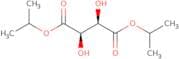
CAS 2217-15-4
:Diisopropyl tartrate
Description:
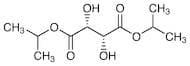
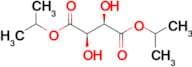
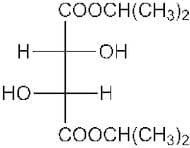
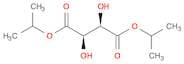
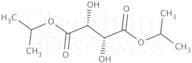
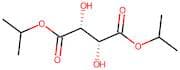
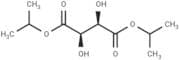
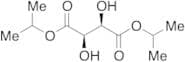
Diisopropyl tartrate, with the CAS number 2217-15-4, is an organic compound that belongs to the class of esters derived from tartaric acid. It is characterized by its colorless to pale yellow liquid form and is known for its low volatility and relatively high boiling point. The compound is soluble in organic solvents such as ethanol and ether but has limited solubility in water due to its hydrophobic isopropyl groups. Diisopropyl tartrate is often utilized as a chiral auxiliary in asymmetric synthesis, aiding in the production of enantiomerically pure compounds. Additionally, it exhibits properties that make it useful as a solvent and in various chemical reactions. Its structure features two isopropyl groups esterified to the hydroxyl groups of tartaric acid, contributing to its unique reactivity and functionality in synthetic organic chemistry. Safety data indicates that it should be handled with care, as with many organic solvents, to avoid potential health hazards.
Formula:C10H18O6
InChI:InChI=1S/C10H18O6/c1-5(2)15-9(13)7(11)8(12)10(14)16-6(3)4/h5-8,11-12H,1-4H3/t7-,8-/m1/s1
InChI key:InChIKey=XEBCWEDRGPSHQH-HTQZYQBOSA-N
SMILES:[C@@H]([C@H](C(OC(C)C)=O)O)(C(OC(C)C)=O)O
Synonyms:- (+)-Diisopropyl <span class="text-smallcaps">L</span>-tartrate
- (+)-Dipt
- (+)-Tartaric acid diisopropyl ester
- <span class="text-smallcaps">L</span>-(+)-Diisopropyl tartrate
- <span class="text-smallcaps">L</span>-(+)-Tartaric acid diisopropyl ester
- Bis(1-methylethyl) [R-(R*,R*)]-2,3-dihydroxybutanedioate
- Butanedioic acid, 2,3-dihydroxy- (2R,3R)-, 1,4-bis(1-methylethyl) ester
- Butanedioic acid, 2,3-dihydroxy- (2R,3R)-, bis(1-methylethyl) ester
- Butanedioic acid, 2,3-dihydroxy-[R-(R*,R*)]-, bis(1-methylethyl) ester
- Diisopropyl (2R,3R)-tartrate
- Diisopropyl L-(+)-tartarate
- Diisopropyl R,R-tartrate
- Diisopropyl tartrate
- Dipropan-2-Yl 2,3-Dihydroxybutanedioate
- L-Dipt
- bis(1-methylethyl) (2R,3R)-2,3-dihydroxybutanedioate
- See more synonyms
Sort by
Purity (%)
0
100
|
0
|
50
|
90
|
95
|
100
Found 9 products.
Diisopropyl L-(+)-Tartrate
CAS:Formula:C10H18O6Purity:>98.0%(GC)Color and Shape:Colorless to Almost colorless clear liquidMolecular weight:234.25(+)-Diisopropyl L-tartrate, 97%
CAS:This Thermo Scientific Chemicals brand product was originally part of the Alfa Aesar product portfolio. Some documentation and label information may refer to the legacy brand. The original Alfa Aesar product / item code or SKU reference has not changed as a part of the brand transition to Thermo SciFormula:C10H18O6Purity:97%Color and Shape:Clear colorless to pale yellow, Liquid or viscous liquidMolecular weight:234.25(+)-Diisopropyl L-tartrate
CAS:Formula:C10H18O6Purity:95%Color and Shape:LiquidMolecular weight:234.2463(+)-Diisopropyl L-tartrate
CAS:Formula:C10H18O6Purity:≥ 99.0%Color and Shape:Colourless to light yellow liquidMolecular weight:234.25L-(+)-Tartaric acid diisopropyl ester
CAS:L-(+)-Tartaric acid diisopropyl esterFormula:C10H18O6Purity:≥95%Color and Shape: clear. almost colourless liquidMolecular weight:234.24631g/molDiisopropyl tartrate
CAS:Diisopropyl tartrate is a reagent for kinetic resolution of racemic allylic alcohols and α-furfuryl amides. It acts by enantioselective epoxidation.Formula:C10H18O6Purity:98%Color and Shape:Clear Colorless LiquidMolecular weight:234.24(+)-Diisopropyl L-Tartrate
CAS:Controlled ProductApplications (+)-Diisopropyl L-Tartrate is a reagent for kinetic resolution of racemic allylic alcohols and α-furfuryl amides by enantioselective epoxidation.
References Lee, E., et al.: J. Org. Chem., 59, 14444 (1994); Jung, M., et al.: J. Am. Chem. Soc., 115, 12208 (1993);Formula:C10H18O6Color and Shape:NeatMolecular weight:234.25(+)-Diisopropyl L-tartrate
CAS:(+)-Diisopropyl L-tartrate is a chiral, hydrophobic, synthetic chemical that is soluble in organic solvents. It has been used as an intermediate for the synthesis of other compounds such as aldehydes and threonine. (+)-Diisopropyl L-tartrate is also used to separate mixtures of enantiomers. This compound has been shown to be effective at extracting styrene from gasoline or methyl esters from crude oil. The optimal extraction temperature is between 60°C and 100°C.
Formula:C10H18O6Purity:Min. 95%Color and Shape:Clear LiquidMolecular weight:234.25 g/mol