CAS 222629-77-8
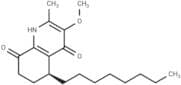
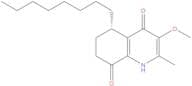
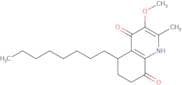
:(5S)-3-methoxy-2-methyl-5-octyl-1,5,6,7-tetrahydroquinoline-4,8-dione
Description:
(5S)-3-methoxy-2-methyl-5-octyl-1,5,6,7-tetrahydroquinoline-4,8-dione, with the CAS number 222629-77-8, is a synthetic organic compound characterized by its complex bicyclic structure, which includes a quinoline moiety. This compound features a methoxy group and an octyl side chain, contributing to its hydrophobic properties. The presence of the tetrahydroquinoline framework suggests potential biological activity, as many compounds with similar structures exhibit pharmacological effects. The stereochemistry indicated by the (5S) designation implies specific spatial arrangements of atoms, which can influence the compound's reactivity and interactions with biological targets. Its dione functional groups suggest it may participate in various chemical reactions, including nucleophilic attacks and redox processes. The compound's solubility, stability, and reactivity can be influenced by its substituents, making it of interest in medicinal chemistry and material science. Further studies would be necessary to fully elucidate its properties and potential applications.
Formula:C19H29NO3
InChI:InChI=1/C19H29NO3/c1-4-5-6-7-8-9-10-14-11-12-15(21)17-16(14)18(22)19(23-3)13(2)20-17/h14H,4-12H2,1-3H3,(H,20,22)/t14-/m0/s1
SMILES:CCCCCCCC[C@H]1CCC(=O)c2c1c(=O)c(c(C)[nH]2)OC
Synonyms:- 4,8-quinolinedione, 1,5,6,7-tetrahydro-3-methoxy-2-methyl-5-octyl-, (5S)-
Sort by
Purity (%)
0
100
|
0
|
50
|
90
|
95
|
100
Found 4 products.
Antidesmone
CAS:Antidesmone from Ajuga decumbens inhibits acute lung injury by modulating MAPK and NF-κB.Formula:C19H29NO3Purity:98%Color and Shape:SolidMolecular weight:319.44Antidesmone
CAS:Antidesmone is a specialized phytochemical product, which is a naturally occurring compound extracted from the plant genus Antidesma, part of the Phyllanthaceae family. Its source lies in various species known for their medicinal properties, mostly found in tropical and subtropical regions. As a bioactive compound, Antidesmone functions through its unique mode of action that involves modulation of biochemical pathways, potentially affecting cellular processes such as inflammation, oxidation, and microbial activity.Formula:C19H29NO3Purity:Min. 95%Molecular weight:319.4 g/mol