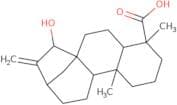
CAS 22338-69-8
:Grandifloric acid
Description:
Grandifloric acid, with the CAS number 22338-69-8, is a naturally occurring organic compound classified as a fatty acid. It is primarily derived from certain plant sources, particularly those belonging to the family of flowering plants. The structure of grandifloric acid features a long hydrocarbon chain with a carboxylic acid functional group, which contributes to its acidic properties. This compound is known for its potential biological activities, including antimicrobial and anti-inflammatory effects, making it of interest in both pharmacological and agricultural research. Additionally, grandifloric acid may play a role in plant metabolism and growth regulation. Its solubility characteristics typically align with those of other fatty acids, being more soluble in organic solvents than in water. As with many organic acids, it can participate in various chemical reactions, including esterification and neutralization, which are relevant in both synthetic and natural processes. Overall, grandifloric acid represents a fascinating subject for further study in the fields of organic chemistry and biochemistry.
Formula:C20H30O3
InChI:InChI=1S/C20H30O3/c1-12-13-5-6-15-18(2)8-4-9-19(3,17(22)23)14(18)7-10-20(15,11-13)16(12)21/h13-16,21H,1,4-11H2,2-3H3,(H,22,23)/t13-,14+,15+,16+,18-,19-,20-/m1/s1
InChI key:InChIKey=GVGJRXSJJHLPGZ-DZAVYMGKSA-N
SMILES:O[C@@H]1[C@]23[C@]([C@@]4(C)[C@](CC2)([C@@](C(O)=O)(C)CCC4)[H])(CC[C@](C3)(C1=C)[H])[H]
Synonyms:- Kaur-16-en-18-oic acid, 15-hydroxy-, (4α,15α)-
- Kaur-16-en-18-oic acid, 15α-hydroxy-
- 15α-Hydroxykaur-16-en-19-oic acid
- (4α,15α)-15-Hydroxykaur-16-en-18-oic acid
- Grandiflorolic acid
Sort by
Purity (%)
0
100
|
0
|
50
|
90
|
95
|
100
Found 3 products.
Grandifloric acid
CAS:<p>Grandifloric acid is a natural product of Siegesbeckia, Asteraceae.</p>Formula:C20H30O3Purity:98%Color and Shape:SolidMolecular weight:318.457Grandifloric acid
CAS:<p>Grandifloric acid is a natural compound, which is primarily an organic acid derived from botanical sources, notably found in certain plant species. This compound operates via several biochemical pathways, exhibiting anti-inflammatory, antimicrobial, and antioxidative properties. Its mode of action includes the modulation of enzyme activities and inhibition of specific signaling pathways, making it a subject of interest for its therapeutic potential.</p>Formula:C20H30O3Purity:Min. 95%Molecular weight:318.4 g/mol