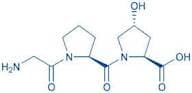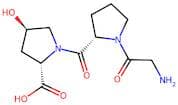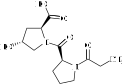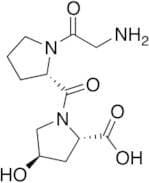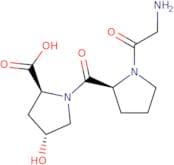
CAS 2239-67-0
:Glycylprolylhydroxyproline
- 1: PN: WO2007017671 PAGE: 49 claimed protein
- 70: PN: WO03006603 SEQID: 76 claimed protein
- <span class="text-smallcaps">L</smallcap>-Proline, 1-(1-glycyl-<smallcap>L</span>-prolyl)-4-hydroxy-
- <span class="text-smallcaps">L</smallcap>-Proline, 1-(1-glycyl-<smallcap>L</span>-prolyl)-4-hydroxy-, trans-
- <span class="text-smallcaps">L</smallcap>-Proline, glycyl-<smallcap>L</span>-prolyl-4-hydroxy-, (4R)-
- Glycylprolylhydroxyproline
- H-Gly-Pro-Hyp-OH
- Proline, 1-(1-glycyl-<span class="text-smallcaps">L</smallcap>-prolyl)-4-hydroxy-, <smallcap>L</span>-
- Proline, 1-(1-glycyl-<span class="text-smallcaps">L</span>-prolyl)-4-hydroxy-
- Tripeptide 29
- glycyl-L-prolyl-3-hydroxy-L-proline
- Proline, 1-(1-glycyl-L-prolyl)-4-hydroxy-, L-
- Gly-Pro-Hyp
- L-Proline, 1-(1-glycyl-L-prolyl)-4-hydroxy-, trans-
- CoChemicalbookllagenTripeptide
- (2S,4R)-1-((S)-1-(2-aMinoacetyl)pyrrolidine-2-carbonyl)-4-hydroxypyrrolidine-2-carboxylicacid
- Proline, 1-(1-glycyl-L-prolyl)-4-hydroxy-
- GLY-PRO-HYDROXY-PRO
- L-Proline, 1-(1-glycyl-L-prolyl)-4-hydroxy-
- L-Proline, glycyl-L-prolyl-4-hydroxy-, (4R)-
- gly-pro-hydroxy-proW/approx.*6%isopropanol
- Tripeptide-29/H-Gly-Pro-Hyp-OH
- Tripeptide-29/Oligopeptide-29
- (2S,4R)-1-((S)-1-(2-aMinoacetyl)pyrrolidine-2-carbonyl)-4-hydroxypyrrolidine-2-carboxylic acid
- gly-pro-hydroxy-pro W/approx.*6% isopropanol
- (4R)-Glycyl-L-prolyl-4-hydroxy-L-proline
- H-Gly-Pro-Hyp-OH (H-3630.0250)
- CAS 2239-67-0 H-GLY-PRO-HYP-OH
- See more synonyms
H-Gly-Pro-Hyp-OH
CAS:Collagen tripeptide. Palmitoylated Gly-Pro-Hyp is used as ingredient in anti-wrinkle cosmetic compositions.Formula:C12H19N3O5Purity:≥ 96%Color and Shape:WhiteMolecular weight:285.3H-Gly-Pro-Hyp-OH
CAS:H-Gly-Pro-Hyp-OH is a potent and oral anti-photoaging collagen peptide and improves the hydration of human skin, elasticity and anti-wrinkle properties.Formula:C12H19N3O5Purity:98.47%Color and Shape:SolidMolecular weight:285.3H-Gly-Pro-Hyp-OH
CAS:Formula:C12H19N3O5Purity:95%~99%Color and Shape:White to Off-white PowderMolecular weight:285.3H-Gly-Pro-Hyp-OH
CAS:Controlled ProductFormula:C12H19N3O5Color and Shape:White To Off-WhiteMolecular weight:285.3H-Gly-Pro-Hyp-OH
CAS:H-Gly-Pro-Hyp-OH is a collagen gel that is extracted from bovine skin. Collagen gel is a dietary supplement that can be applied to wounds and burns to promote healing. Collagen gel contains the amino acids glycine, proline, hydroxyproline, and hypochlorous acid. It also has an anti-inflammatory cytokine called IL-10. Hydrogen bonds form between the amino acids in collagen gel to give it its strength and stability. The LC-MS/MS method was used to identify the sequences of this peptide in order to confirm its identity. Collagen gel is neutral at pH 7 and has no effect on cellular function at this pH. The carboxy terminal of collagen gel is trifluoroacetic acid which can cause liver cells to die when ingested orally or intravenously due to its toxicity.
Formula:C12H19N3O5Purity:Min. 98 Area-%Color and Shape:White PowderMolecular weight:285.3 g/molRef: 3D-FG109052
Discontinued product