CAS 22411-59-2
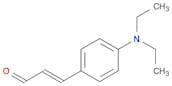
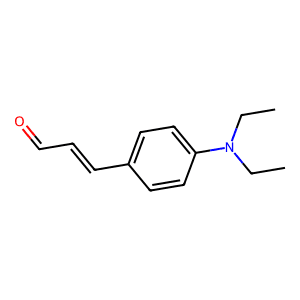
:trans-4-(diethylamino)cinnamaldehyde
Description:
Trans-4-(diethylamino)cinnamaldehyde is an organic compound characterized by its structure, which features a cinnamaldehyde backbone with a diethylamino group at the trans position of the double bond. This compound typically appears as a yellow to orange liquid and is known for its aromatic properties, contributing to its potential applications in organic synthesis and as a dye or pigment. It has a relatively high boiling point due to the presence of the aldehyde functional group, which can participate in various chemical reactions, including condensation and nucleophilic addition. The diethylamino group enhances its solubility in organic solvents and may influence its reactivity and biological activity. Additionally, this compound may exhibit fluorescence, making it useful in certain analytical applications. Safety considerations include handling it in a well-ventilated area and using appropriate personal protective equipment, as it may pose health risks upon exposure. Overall, trans-4-(diethylamino)cinnamaldehyde is a versatile compound with significant relevance in both research and industrial contexts.
Formula:C13H17NO
InChI:InChI=1/C13H17NO/c1-3-14(4-2)13-9-7-12(8-10-13)6-5-11-15/h5-11H,3-4H2,1-2H3/b6-5+
Synonyms:- 3-[4-(Diethylamino)Phenyl]Prop-2-Enal
- (2E)-3-[4-(diethylamino)phenyl]prop-2-enal
Sort by
Purity (%)
0
100
|
0
|
50
|
90
|
95
|
100
Found 4 products.
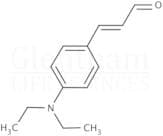
trans-4-(Diethylamino)cinnamaldehyde
CAS:Formula:C13H17NOPurity:95%Color and Shape:SolidMolecular weight:203.28024-(Diethylamino)cinnamaldehyde
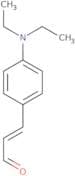
CAS:4-(Diethylamino)cinnamaldehydePurity:98%Molecular weight:203.28g/moltrans-4-(Diethylamino)cinnamaldehyde
CAS:Trans-4-(Diethylamino)cinnamaldehyde is a molecule that has been systematically studied with several techniques, such as x-ray crystallography. It has been shown to be a fluorophore and can be used as a fluorescent probe. Trans-4-(Diethylamino)cinnamaldehyde can be used in the fluorescence method in which it reacts with other molecules and emits light. This reaction scheme is based on the principle of irradiation by UV light or visible light to produce an excited state. Fluorescence is detected at various wavelengths depending on the dye used. Trans-4-(Diethylamino)cinnamaldehyde also emits fluorescence when irradiated with ultraviolet light, which is often referred to as "violet" fluorescence. The wavelength of this emission is 365 nm and it can be detected using high yield techniques, such as fluorometers.Formula:C13H17NOPurity:Min. 95%Color and Shape:PowderMolecular weight:203.28 g/mol