CAS 2243-61-0
:1,4-Naphthalenediamine
Description:
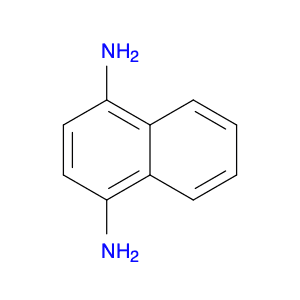
1,4-Naphthalenediamine, with the CAS number 2243-61-0, is an organic compound characterized by its structure, which features two amino groups (-NH2) attached to the naphthalene ring at the 1 and 4 positions. This compound appears as a solid, typically in the form of a white to light yellow crystalline powder. It is soluble in organic solvents such as ethanol and acetone but has limited solubility in water. 1,4-Naphthalenediamine is primarily used in the production of dyes, pigments, and as an intermediate in the synthesis of various chemicals. It exhibits properties such as being a reducing agent and can participate in various chemical reactions, including diazotization and coupling reactions. However, it is important to note that 1,4-naphthalenediamine is considered hazardous, with potential health risks including skin and respiratory irritation, and it may be a carcinogen. Proper handling and safety precautions are essential when working with this substance in laboratory or industrial settings.
Formula:C10H10N2
InChI:InChI=1S/C10H10N2/c11-9-5-6-10(12)8-4-2-1-3-7(8)9/h1-6H,11-12H2
InChI key:InChIKey=OKBVMLGZPNDWJK-UHFFFAOYSA-N
SMILES:NC=1C2=C(C(N)=CC1)C=CC=C2
Synonyms:- 1,4-Naphthalenediamine
- 1,4-Diaminonaphthalene
- 1,4-Naphthylenediamine
Sort by
Purity (%)
0
100
|
0
|
50
|
90
|
95
|
100
Found 4 products.
1,4-Diaminonaphthalene
CAS:1,4-Diaminonaphthalene is an organic compound that belongs to the group of small molecule drugs. It is a cleavage product of naphthalene and has been shown to inhibit the expression of target genes in biological studies. 1,4-Diaminonaphthalene also has anti-tumor properties and can be used for the treatment of cancer diseases. 1,4-Diaminonaphthalene has chemical diversity due to its two different isomers. One isomer (1,4-diaminoanthracene) exhibits strong UV absorption and can be used as a target gene expression probe. The other isomer (1,2-diaminobenzene) has amine groups that are more reactive than those in the first isomer and can be used as a growth factor.Formula:C10H10N2Purity:Min. 95%Molecular weight:158.2 g/mol