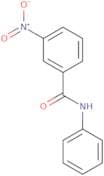
CAS 2243-73-4
:3-nitro-N-phenylbenzamide
Description:
3-Nitro-N-phenylbenzamide, with the CAS number 2243-73-4, is an organic compound characterized by its amide functional group and the presence of both nitro and phenyl substituents. This compound features a benzamide structure where a nitro group is positioned at the meta position relative to the amide group, and a phenyl group is attached to the nitrogen atom of the amide. The presence of the nitro group typically imparts increased polarity and can influence the compound's reactivity, making it a potential candidate for various chemical reactions, including electrophilic aromatic substitution. The compound is likely to exhibit moderate solubility in organic solvents due to its aromatic nature, while its amide functionality may contribute to hydrogen bonding capabilities. 3-Nitro-N-phenylbenzamide may also possess biological activity, making it of interest in pharmaceutical research. As with many nitro compounds, it should be handled with care due to potential toxicity and environmental concerns.
Formula:C13H10N2O3
InChI:InChI=1/C13H10N2O3/c16-13(14-11-6-2-1-3-7-11)10-5-4-8-12(9-10)15(17)18/h1-9H,(H,14,16)
SMILES:c1ccc(cc1)N=C(c1cccc(c1)N(=O)=O)O
Synonyms:- benzamide, 3-nitro-N-phenyl-
- 3-Nitro-N-phenylbenzamide
Sort by
Purity (%)
0
100
|
0
|
50
|
90
|
95
|
100
Found 1 products.
3-Nitrobenzanilide
CAS:3-Nitrobenzanilide is an intermediate in the synthesis of a number of pharmaceuticals and pesticides. It is used as an activated reagent to introduce the benzoyl group by reaction with dimethylformamide. 3-Nitrobenzanilide can be prepared from phenylacetonitrile, benzoyl chloride, and ammonia or from nitrobenzene and sodium cyanide. The nature of the nitro group on the benzene ring determines whether the product is a diazo compound or a carbonyl compound. 3-Nitrobenzanilide has been shown to have plant disease control properties via its ability to inhibit plant enzymes such as acetylcholine esterase.
Formula:C13H10N2O3Purity:Min. 95%Molecular weight:242.23 g/mol