CAS 225110-25-8
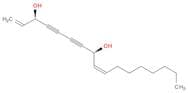
:1,9-Heptadecadiene-4,6-diyne-3,8-diol,(3R,8S,9Z)-
Description:
1,9-Heptadecadiene-4,6-diyne-3,8-diol, also known by its CAS number 225110-25-8, is a complex organic compound characterized by its unique structure featuring multiple double and triple bonds, as indicated by the presence of diene and diyne functional groups. This compound contains a long carbon chain, specifically 17 carbon atoms, which contributes to its hydrophobic nature. The presence of hydroxyl (-OH) groups at the 3 and 8 positions introduces polar characteristics, allowing for potential hydrogen bonding and increased solubility in polar solvents. The stereochemistry of the molecule is defined by the (3R,8S,9Z) configuration, indicating specific spatial arrangements of the substituents around the chiral centers and the double bond. Such structural features may influence its reactivity, stability, and potential applications in organic synthesis or as a biochemical probe. Overall, this compound exemplifies the complexity and diversity of organic molecules, particularly those with multiple functional groups and stereochemical configurations.
Formula:C17H24O2
Synonyms:- (+)-(3R,8S)-Falcarindiol
- 3(R),8(S),9(Z)-Falcarindiol
Sort by
Purity (%)
0
100
|
0
|
50
|
90
|
95
|
100
Found 6 products.
(+)-(3R,8S)-Falcarindiol
CAS:(+)-(3R,8S)-Falcarindiol is a potential new anticancer agent that exerts its activity through inducing ER stress and apoptosis.Formula:C17H24O2Purity:97.06%Color and Shape:SolidMolecular weight:260.37(3R,8S)-Falcarindiol
CAS:(3R,8S)-Falcarindiol is a glycol ether that is found in the bark of the Dichapetalum cymosum tree. It has been shown to have potent anti-infective properties and can be used as an adjuvant treatment for infectious diseases. (3R,8S)-Falcarindiol has been shown to exhibit significant cytotoxicity against HL-60 cells and dextran sulfate, which may be due to its ability to inhibit energy metabolism by blocking enzymes such as succinic dehydrogenase. The anti-inflammatory effects of (3R,8S)-falcarindiol are due to its inhibition of prostaglandin synthesis and production of nitric oxide. This compound also inhibits apoptosis in Hl-60 cells by acting as a substrate for abcg2, one of the proteins involved in apoptosis pathways. Analysis of this compound is done using preparative high performance liquid chromatography.Formula:C17H24O2Purity:Min. 98 Area-%Color and Shape:Clear LiquidMolecular weight:260.37 g/mol(3R,8S)-Falcarindiol
CAS:Controlled ProductApplications Falcarindiol was isolated as an algicidal principle against the harmful red tide dinoflagellate, Heterocapsa circularisquama, from Notopterygii Rhizoma through bioassay-guided separation.To determine the ambiguous absolute structure of this active principle, all three stereoisomers as well as falcarindiol were synthesized. As a result of intensive analytical of their physicochemical properties, the configuration of Falcarinfiol was revealed to be 3R,8S. (3S,8S)- and (3S,8R)-isomers were found to exhibit more potent algicidal activity than (3R,8S)-Falcarindiol isolated from Notopterygii Rhizoma.
References Nitz, S., et al.: J. Agric. Food Chem., 38, 1445 (1990), Alamsjah, M., et al.: J. Appl. Phycol., 20, 713 (2008),Formula:C17H24O2Color and Shape:NeatMolecular weight:260.371